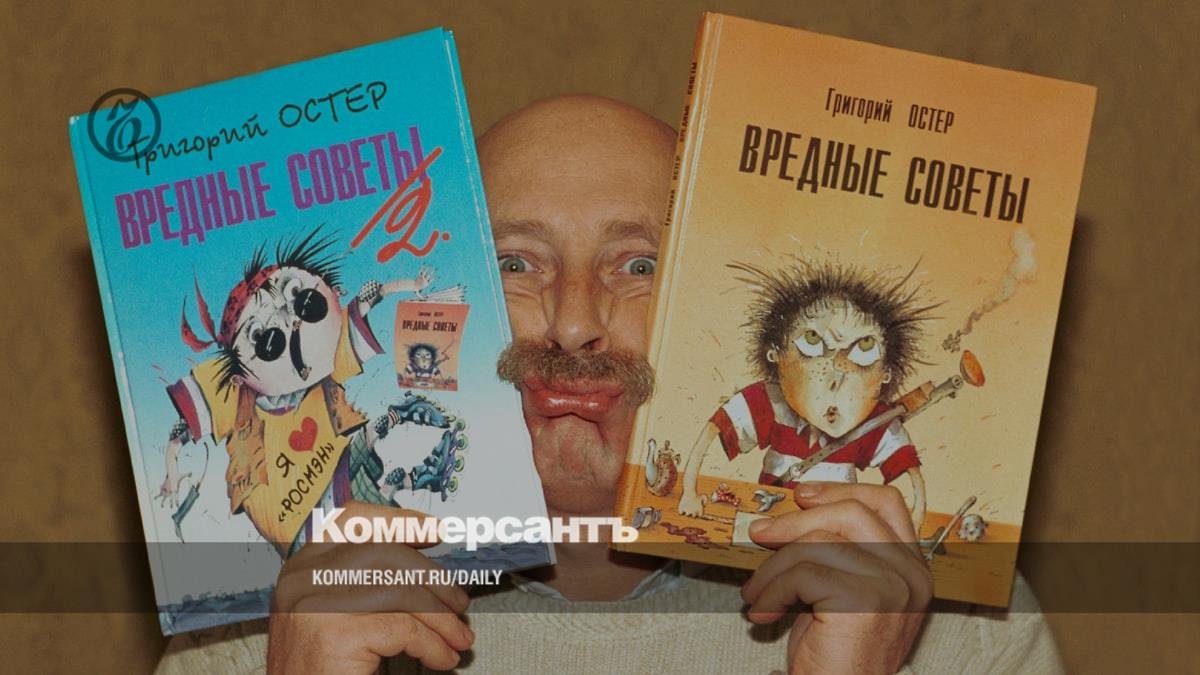
As Kommersant found out, the Chairman of the Investigative Committee of Russia (ICR) Alexander Bastrykin gave a sensational order to check the books of the children’s writer Grigory Oster because of the report of State Duma deputy Maria Butina. It claims that Mr. Auster’s work “destroys the moral foundation of a child under the guise of humor and education.” Sources in law enforcement agencies confirmed to Kommersant that investigators will check the works of Grigory Oster, in particular, the fairy tale “The Book of the Cannibal’s Tasty and Healthy Food.” AST Publishing House and the Russian Book Union have not yet received requests regarding Mr. Oster’s books.
Stingy message about checking the books of children’s writer Grigory Oster for the content of “questionable principles from a pedagogical point of view” appeared on the website of the Investigative Committee on Tuesday, April 21. The press service of the department stated that the Chairman of the Investigative Committee, Alexander Bastrykin, gave such an instruction at a meeting of the Coordination Council on assistance to children affected by humanitarian disasters, natural disasters, terrorist attacks and armed conflicts.
The news immediately spread on the Internet – for the second day now, social network users have been composing humorous poems in the style of Mr. Oster’s “Bad Advice” about both the Investigative Committee and current events in general. At the same time, from the message on the ICR website, it remains unclear why Alexander Bastrykin suddenly became interested in the works of the famous children’s writer. It is only stated that “the event participants discussed a wide range of issues related to the prevention of teenage crime, as well as the development of measures aimed at increasing the safety of children, including in the digital environment,” and that “the content of children’s literature was discussed separately.”
“Kommersant” spoke with members of the council who were present at the event and reconstructed the course of events. As it turned out, the name of Grigory Oster was mentioned during the speech of State Duma deputy Maria Butina (ER).
Especially for the meeting, she prepared a report “Destructive content in children’s literature as a risk factor for unlawful behavior of minors,” which, among other things, mentioned critical statements about SVO, allegedly belonging to Grigory Oster (Kommersant has a presentation of the report).
In addition, Mrs. Butina saw in the writer’s work “the destruction of the moral foundation of a child under the guise of humor and education.” At the meeting, she quoted a problem from the book “A Beloved Guide to Mathematics,” which says: “Fourteen children learned to swim. Three of them cannot swim yet, and two have already drowned. How many children have already learned to swim and haven’t drowned yet?” The deputy also had questions about the fairy tale “The Book of the Cannibal’s Tasty and Healthy Food” and the collection of stories “School of Horror”: there she was outraged by the “strangulation table”, where “the strangled are multiplied by the strangled.”
Finally, Maria Butina called Grigory Oster’s most famous book “Bad Advice” – a collection of humorous poems with instructions on the contrary – “legitimization of cruelty.” The parliamentary presentation gives an example of such “cruelty” – the poem “Beat frogs with sticks. This is very interesting. / Tear off the wings of the flies, let them run on foot. / Train daily, and a happy day will come / You will be accepted into some kingdom as the Chief Executioner.”
At the end of her speech, Maria Butina proposed removing Grigory Oster’s books from public access, conducting an “unscheduled audit” of the writer’s work and sending its results to the Ministry of Education and Roskomnadzor
According to Kommersant’s interlocutors, at the meeting Mr. Bastrykin supported the initiative. As Kommersant’s sources in law enforcement agencies clarified, on the instructions of Alexander Bastrykin, the inspection will be carried out by employees of the department’s central apparatus. In particular, the object of study will be the collection of stories “School of Horror” and the fairy tale “The Book of the Cannibal’s Tasty and Healthy Food.”
As a rule, as part of such checks, various studies or examinations are prescribed, including psychological and linguistic ones. She must evaluate the impact that the content of the work has on the reader, especially the minor. Based on the results of the inspection, a procedural decision is made – for example, to initiate a criminal case or transfer materials to Roskomnadzor and the prosecutor’s office, which can prohibit or limit the distribution of the work.
Kommersant was unable to obtain a comment from Grigory Oster himself. Publishing house AST collaborating with him Kommersant reportedthat “they have not received any requests from the Investigative Committee, the prosecutor’s office or other structures.” AST also emphasized that the segment of children’s literature is “especially carefully regulated” by law, and recalled that the works of Grigory Oster have been published for more than 30 years, so “more than one generation of readers has grown up on them.”
Speaking about the claims against “Bad Advice,” the publisher explained that these poems “in an ironic form instill safe behavior skills, ridiculing greed, rudeness, deception and whims, acting as a “vaccination against stupidity.”
The publishing house expressed its readiness to provide “all necessary information and expert opinions” if they receive official requests from supervisory authorities.
The Russian Book Union reminded Kommersant that their structure includes an expert center, which, at the request of the authorities, “checks books for compliance with the law.” However, no one contacted them regarding the books of Grigory Oster.
Writer Denis Dragunsky, in a conversation with Kommersant, urged not to confuse fiction with instructions on the rules of behavior. “I don’t quite understand what the word “check” means in this situation,” he admitted. “Checking whether the sour cream fat content stated on the label corresponds to the actual fat content in the product—everything is clear here. But what about children’s books, and not only books? How and with what to compare them? Really with English children’s books of the Victorian era, where all the characters are well-behaved and prim? Mr. Dragunsky recalled that even in classic Soviet children’s books there are often “very rowdy children and teenagers who do not particularly respect teachers and adults in general, and are sometimes hooligans and thieves.” However, these books “grew up the generations that won the Great Patriotic War, and then built factories and hydroelectric power stations,” the writer emphasized.