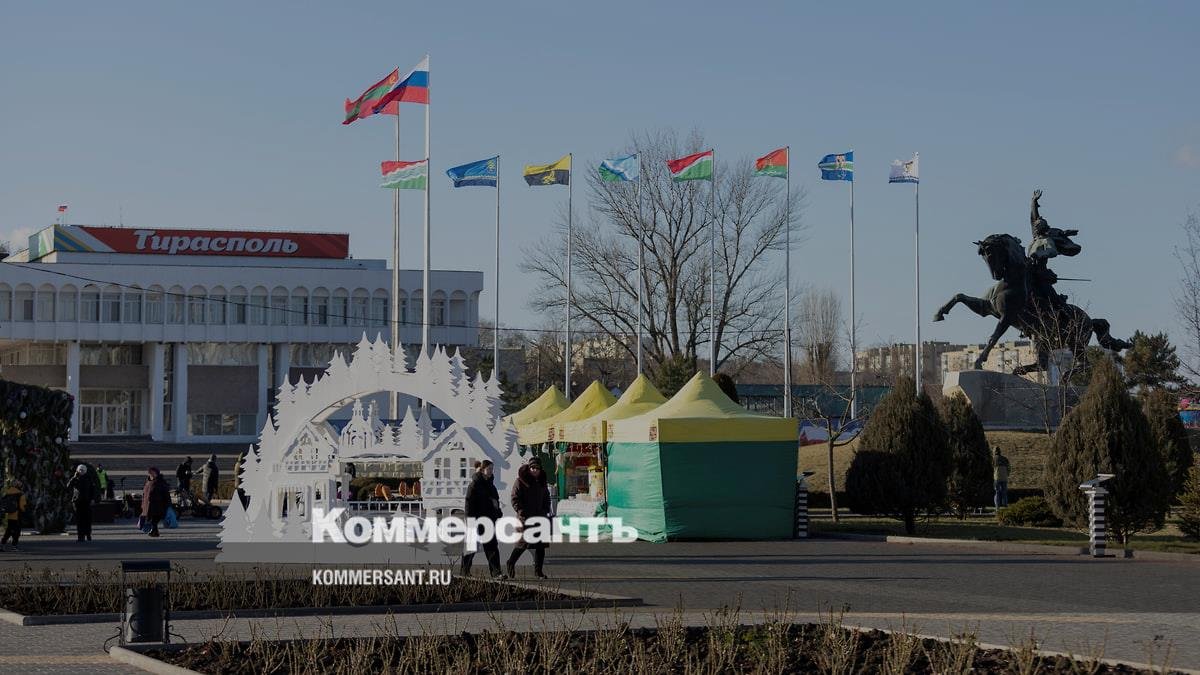
The excitement around obtaining Russian passports in the unrecognized Transnistria does not subside. A month after Russian President Vladimir Putin signed a decree on a simplified procedure for admitting residents of the unrecognized republic to Russian citizenship, the number of applications submitted exceeded 50 thousand, despite the fact that the population of Transnistria is 450 thousand people. A Kommersant correspondent observed the unprecedented scale of the process of acquiring new citizenship in Tiraspol. Vladimir Mavrin.
Since the end of May, people have literally occupied the entrance to the Russian consular service point in the very center of Tiraspol. Many stand in line for several hours in 30-degree heat just to get a short consultation. Although this is not necessary: all information is publicly available.
To obtain Russian citizenship under a simplified scheme, you need to prove the fact of permanent residence in Transnistria for the last five years and have a local passport.
In the queue you can find people with an impressive collection of citizenships. Having Moldovan, Ukrainian, Romanian passports, they also come here for a Russian one. They say – just in case. But there are many for whom a document with a double-headed eagle is vital.
Tiraspol resident Natalya talks about her problem in line. She is the guardian of a twelve-year-old teenager and cannot go with him to his relatives in Russia. She was denied a Moldovan passport, having invalidated the documents issued by the social protection center in Transnistria.
— According to the new law, I must register on Moldovan territory and live there for several months. And the commission will check what conditions we are in. And only then will they decide whether to give us papers. With Russian citizenship, everything is simpler,” says Natalya.
She planned to go to Russia by bus, but did not receive Moldovan documents. You won’t be able to travel on land with a Russian passport. You need visas to travel through the EU. But on a connecting plane the way is open.
By mid-June the queue had decreased slightly. The consulate says: people have learned to leave applications online.
— I added my grandmother to the electronic queue. Then her friend called me and asked me to record her too. Further down the chain, six more people contacted me. These are lonely pensioners, how can you not help? Now I am monitoring eight applications at once. For some, the queue froze, for others it was delayed by a month. I think that all my wards will receive passports before the New Year,” says Elena Smolenskaya, a resident of the city of Bendery.
Colombian Giselle came for a consultation with a friend. She has citizenship of her native country. She is married to a Transnistrian and has been living in the region for more than five years. There is no local passport, but there is a residence permit. Giselle didn’t want to talk to the press, but a friend said that she was really looking forward to her Russian passport. He has no right to apply for Moldovan and Ukrainian. But the set of Transnistrian documents that we have allows Giselle to acquire Russian citizenship.
Previously, residents of the region had to prove their right to a Russian passport for years and collect a bunch of certificates. Now the procedure is faster and more transparent. And for many, the decree of the Russian President became a salvation. There are thousands of people in Transnistria who are not allowed to travel abroad and do not have internationally recognized documents.
— For years I sat only with a Transnistrian passport. They didn’t give me Moldavian; I was born in Belarus. I’ve lived here for over 50 years and haven’t been able to go anywhere for a long time. Now I called the consulate and told about my situation. They tell me: yes, you can get Russian citizenship. Sign up and submit your documents,” says Nina Ivanovna from the city of Dnestrovsk. The pensioner is over 80 and has no plans to go abroad. But he says that a Russian passport is a guarantee of reliability. Now the woman wants to apply for a Russian pension.
The Transnistrian passport is not recognized by anyone; it is impossible to travel outside of Moldova with it. Russian citizenship opens access to a whole range of social and legal opportunities. We are talking about pensions, consular protection, simplified access to Russian educational programs and the opportunity to participate in Russian elections.
For many residents of the region, having a Russian passport has long become not so much a political as a practical issue.
According to the Ministry of Foreign Affairs of Transnistria, the load on the consular post has increased several times. Registration for the initial appointment is filled months in advance. Even shadow business has appeared. Intermediaries offer places in queues or assistance in quickly collecting certificates. Transnistrian law enforcement agencies say they are scammers.
Historically, many Pridnestrovians have two or three passports. The most common combinations are an internal passport of the PMR plus a passport of Moldova, Ukraine or Russia. Legal travel abroad always required additional documents.
A passport for a resident of Transnistria is not just proof of citizenship. Russian citizenship gives the right to receive Russian pensions and benefits. For a region with a low standard of living, this is critically important. In conditions of inflation, a sharp rise in prices for utilities and the strengthening of the Russian ruble, the Russian pension looks more attractive than the local one. Many older people seek to obtain documents precisely for the sake of this stability.
In addition, a Russian passport provides access to the Russian labor market. The number of jobs in Transnistria is limited, young people leave the region in search of work.
The Moldovan authorities view the mass issuance of Russian passports in Transnistria with great concern. The Bureau for Reintegration under the Moldovan government has repeatedly stated that passporting the population on the left bank of the Dniester complicates the process of peaceful resolution of the conflict.
Since the end of 2025, Chisinau has complicated the procedure for recognizing citizenship for persons born in Transnistria. Now, in order to obtain a Moldovan passport, you need to pass exams on knowledge of the language and the Constitution of Moldova. And before that, go through a long bureaucratic process and wait at least a year for your turn.
A Kommersant correspondent spoke with three Pridnestrovians who were preparing documents to obtain Moldovan citizenship in 2026. Each of them was told by the Public Services Agency of Moldova: it will be very difficult to pass the language exam due to stricter requirements.
It is not enough just to obtain a Russian passport; you need to obtain it physically. And here the main technical problem arises. Due to the lack of direct flights between Moscow and Chisinau, logistics have become more complicated. Delivery of passport forms to Tiraspol takes a long time. Russian diplomats are forced to get to Moldova in transit through third countries. Moldovan border guards carefully check cargo and documents. There have been cases when Russian diplomats were not allowed into the country or were detained at the border for additional checks. All this slows down the work of the exit consular post in Tiraspol. The equipment wears out, and it is extremely difficult to bring new parts or additional stations for taking biometric data. As a result of technical limitations, there are huge queues for submitting applications.
The Transnistrian authorities are trying to negotiate with the Russian side to increase the staff of consular workers in Tiraspol. So far, no fundamental solution to the problem has been found. The consular post is operating at the limit of its technical capabilities. Meanwhile, the number of prepared document packages continues to grow.