Monday, May 4, 2026
    The GeoStrategic Consensus
    No Result
    View All Result
    • Login
    • HOME
    • AMERICAS
      • Argentina
      • Brazil
      • Canada
      • Chile
      • Colombia
      • Costa Rica
      • Cuba
      • Dominican Republic
      • Ecuador
      • El Salvador
      • Greenland
      • Guatemala
      • Honduras
      • Mexico
      • Nicaragua
      • Panama
      • Paraguay
      • Peru
      • United States
      • Uruguay
      • Venezuela
    • ASIA-PACIFIC
      • Australia
      • Brunei Darussalam
      • Cambodia
      • China
      • Federated States of Micronesia
      • Fiji
      • Indonesia
      • Japan
      • Kiribati
      • Laos
      • Malaysia
      • Marshall Islands
      • Mongolia
      • Myanmar
      • Nauru
      • New Zealand
      • North Korea
      • Palau
      • Papua New Guinea
      • Philippines
      • Samoa
      • Singapore
      • Solomon Islands
      • South Korea
      • Taiwan
      • Thailand
      • Timor-Leste
      • Tonga
      • Tuvalu
      • Vanuatu
      • Vietnam
    • CARICOM
      • CARICOM – Non-English
        • Haiti
        • Suriname
      • CARICOM Associates
        • Anguilla
        • Bermuda
        • British-Virgin-Islands
        • Cayman-Islands
        • Curacao
        • Turks-and-Caicos
      • CARICOM English
        • Antigua and Barbuda
        • Barbados
        • Belize
        • Dominica
        • Grenada
        • Guyana
        • Jamaica
        • Montserrat
        • Saint Kitts and Nevis
        • Saint Lucia
        • Saint Vincent and the Grenadines
        • The Bahamas
        • Trinidad and Tobago
    • EURASIA
      • Armenia
      • Azerbaijan
      • Balarus
      • Georgia
      • Kazakhstan
      • Kyrgyzstan
      • Moldova
      • Russia
      • Tajikistan
      • Turkmenistan
      • Ukraine
      • Uzbekistan
    • EUROPE
      • Albania
      • Andorra
      • Austria
      • Bosnia and Herzegovina
      • Bulgaria
      • Croatia
      • Cyprus
      • Czech Republic
      • Denmark
      • Estonia
      • Finland
      • France
      • Germany
      • Greece
      • Holy See
      • Hungary
      • Iceland
      • Ireland
      • Italy
      • Kosovo
      • Latvia
      • Liechtenstein
      • Lithuania
      • Luxembourg
      • Malta
      • Monaco
      • Montenegro
      • Netherlands
      • North Macedonia
      • Norway
      • Poland
      • Portugal
      • Romania
      • San Marino
      • Serbia
      • Slovakia
      • Slovenia
      • Spain
      • Sweden
      • Switzerland
      • United Kingdom
    • MIDDLE EAST AND NORTH AFRICA
      • Algeria
      • Bahrain
      • Egypt
      • Iran
      • Iraq
      • Israel
      • Jordan
      • Kuwait
      • Lebanon
      • Lybia
      • Morocco
      • Oman
      • Palestinian Territories
      • Qatar
      • Saudi Arabia
      • Syria
      • Tunisia
      • Turkey
      • United Arab Emirates
      • Western Sahara
      • Yemen
    • SOUTH ASIA
      • Afghanistan
      • Bangladesh
      • Bhutan
      • India
      • Maldives
      • Nepal
      • Pakistan
      • Sri Lanka
    • SUB-SAHARAN AFRICA
      • Angola
      • Benin
      • Botswana
      • Burkina Faso
      • Burundi
      • Cabo Verde
      • Cameroon
      • Central African Republic
      • Chad
      • Comoros
      • Cote d’Ivoire
      • Democratic Republic of the Congo
      • Djibouti
      • Equatorial Guinea
      • Eritrea
      • Eswatini
      • Ethiopia
      • Gabon
      • Gambia
      • Ghana
      • Guinea
      • Guinea Bissau
      • Kenya
      • Lesotho
      • Liberia
      • Madagascar
      • Malawi
      • Mali
      • Mauritania
      • Mauritius
      • Mozambique
      • Namibia
      • Niger
      • Nigeria
      • Republic of the Congo
      • Rwanda
      • Sao Tome and Principe
      • Senegal
      • Seychelles
      • Sierra Leone
      • Somalia
      • South Africa
      • South Sudan
      • Sudan
      • Tanzania
      • Togo
      • Uganda
      • Zambia
      • Zimbabwe
    • HOME
    • AMERICAS
      • Argentina
      • Brazil
      • Canada
      • Chile
      • Colombia
      • Costa Rica
      • Cuba
      • Dominican Republic
      • Ecuador
      • El Salvador
      • Greenland
      • Guatemala
      • Honduras
      • Mexico
      • Nicaragua
      • Panama
      • Paraguay
      • Peru
      • United States
      • Uruguay
      • Venezuela
    • ASIA-PACIFIC
      • Australia
      • Brunei Darussalam
      • Cambodia
      • China
      • Federated States of Micronesia
      • Fiji
      • Indonesia
      • Japan
      • Kiribati
      • Laos
      • Malaysia
      • Marshall Islands
      • Mongolia
      • Myanmar
      • Nauru
      • New Zealand
      • North Korea
      • Palau
      • Papua New Guinea
      • Philippines
      • Samoa
      • Singapore
      • Solomon Islands
      • South Korea
      • Taiwan
      • Thailand
      • Timor-Leste
      • Tonga
      • Tuvalu
      • Vanuatu
      • Vietnam
    • CARICOM
      • CARICOM – Non-English
        • Haiti
        • Suriname
      • CARICOM Associates
        • Anguilla
        • Bermuda
        • British-Virgin-Islands
        • Cayman-Islands
        • Curacao
        • Turks-and-Caicos
      • CARICOM English
        • Antigua and Barbuda
        • Barbados
        • Belize
        • Dominica
        • Grenada
        • Guyana
        • Jamaica
        • Montserrat
        • Saint Kitts and Nevis
        • Saint Lucia
        • Saint Vincent and the Grenadines
        • The Bahamas
        • Trinidad and Tobago
    • EURASIA
      • Armenia
      • Azerbaijan
      • Balarus
      • Georgia
      • Kazakhstan
      • Kyrgyzstan
      • Moldova
      • Russia
      • Tajikistan
      • Turkmenistan
      • Ukraine
      • Uzbekistan
    • EUROPE
      • Albania
      • Andorra
      • Austria
      • Bosnia and Herzegovina
      • Bulgaria
      • Croatia
      • Cyprus
      • Czech Republic
      • Denmark
      • Estonia
      • Finland
      • France
      • Germany
      • Greece
      • Holy See
      • Hungary
      • Iceland
      • Ireland
      • Italy
      • Kosovo
      • Latvia
      • Liechtenstein
      • Lithuania
      • Luxembourg
      • Malta
      • Monaco
      • Montenegro
      • Netherlands
      • North Macedonia
      • Norway
      • Poland
      • Portugal
      • Romania
      • San Marino
      • Serbia
      • Slovakia
      • Slovenia
      • Spain
      • Sweden
      • Switzerland
      • United Kingdom
    • MIDDLE EAST AND NORTH AFRICA
      • Algeria
      • Bahrain
      • Egypt
      • Iran
      • Iraq
      • Israel
      • Jordan
      • Kuwait
      • Lebanon
      • Lybia
      • Morocco
      • Oman
      • Palestinian Territories
      • Qatar
      • Saudi Arabia
      • Syria
      • Tunisia
      • Turkey
      • United Arab Emirates
      • Western Sahara
      • Yemen
    • SOUTH ASIA
      • Afghanistan
      • Bangladesh
      • Bhutan
      • India
      • Maldives
      • Nepal
      • Pakistan
      • Sri Lanka
    • SUB-SAHARAN AFRICA
      • Angola
      • Benin
      • Botswana
      • Burkina Faso
      • Burundi
      • Cabo Verde
      • Cameroon
      • Central African Republic
      • Chad
      • Comoros
      • Cote d’Ivoire
      • Democratic Republic of the Congo
      • Djibouti
      • Equatorial Guinea
      • Eritrea
      • Eswatini
      • Ethiopia
      • Gabon
      • Gambia
      • Ghana
      • Guinea
      • Guinea Bissau
      • Kenya
      • Lesotho
      • Liberia
      • Madagascar
      • Malawi
      • Mali
      • Mauritania
      • Mauritius
      • Mozambique
      • Namibia
      • Niger
      • Nigeria
      • Republic of the Congo
      • Rwanda
      • Sao Tome and Principe
      • Senegal
      • Seychelles
      • Sierra Leone
      • Somalia
      • South Africa
      • South Sudan
      • Sudan
      • Tanzania
      • Togo
      • Uganda
      • Zambia
      • Zimbabwe
    No Result
    View All Result
    Agentially
    No Result
    View All Result
    Home AMERICAS Canada

    Cold front: Inside NATO’s race to secure the Arctic

    The Analyst by The Analyst
    April 7, 2026
    in Canada
    Cold front: Inside NATO’s race to secure the Arctic


    No matter where you go and who you talk with in defence circles these days, there’s one word — one region — on the lips of most people.

    READ ALSO

    What airlines are supposed to do when uncontrollable circumstances lead to flight disruptions

    Reeling from crisis, P.E.I.’s oyster industry hopes disease-resistant seed from U.S. helps

    The Arctic.

    And it’s spoken with a unique, newfound sense of urgency. 

    Defending the region has become the new rallying cry for Canada and NATO writ large. 

    Without question a lot of it is being driven by U.S. President Donald Trump’s threats to annex Greenland from Denmark by force and his opaque security concerns that may be code for coveting critical minerals. 

    To say that the Arctic — particularly Canada’s North — has suffered from benign security neglect would be an understatement. 

    Two men in suits walk off a large military cargo plane.
    Former NATO secretary general Jens Stoltenberg and former prime minister Justin Trudeau arrive in Cambridge Bay, Nunavut, in 2022. (Jason Franson/The Canadian Press)

    Not even former NATO secretary general Jens Stoltenberg’s visit to Cambridge Bay in 2022 — and his warning that the fastest, easiest way to attack the United States would be through the Arctic — was enough to fully arouse interest and urgency, both in this country and across the alliance as a whole.

    With Russia’s grey zone war in Europe now in full swing and Trump’s now muted but still lingering threats toward Greenland, NATO is scrambling to defend the top of the world. 

    It has established an initiative known as Arctic Sentry. 

    A senior Canadian defence official, speaking on background, said the major tenets of the plan were drafted several years ago by the Canadian delegation at NATO in co-operation with the U.K. at a time when it was a struggle to get the alliance to focus on the Far North.

    Arctic Sentry is not a mission, per se, with defined parameters and objectives. It is an evolving collection of training and surveillance activities being pulled under one umbrella. 

    WATCH | More about Arctic defence:

    Who’s defending Canada’s Arctic?

    For Radio-Canada/RAD, Julia Pagé and director Frédéric Lacelle go to the Arctic to join the Canadian Rangers on patrol in extreme conditions to see first hand how armed forces are preparing to defend the northern border.

    From Icelandic air patrols, to emerging under-ice dangers faced by submarines, to simply surviving and fighting in the frozen wilderness, the alliance is on a learning curve and faces a number of challenges in securing its new cold front.

    CBC News has spoken with more than a dozen senior military commanders and planners — both on the record and on background — about the difficulties inherent in improving security in one of the most inhospitable environments in the world — and over the vast distances involved.

    Simply knowing what’s going on in the Arctic is one of the most pressing — and vexing — concerns. The drone and satellite images that seem to instantly flood our social media and television feeds leave the perception of near-constant surveillance.

    But that is not the reality of the High North.

    “In the Arctic it’s quite hard to get situational awareness,” said Norwegian Maj.-Gen. Frode Kristoffersen, the deputy commander of NATO Joint Forces Command in Norfolk, Va., which is responsible for the Arctic.

    “[It’s] a vast area with few sensors, so situational awareness in the Arctic is an objective.”

    WATCH | NATO deputy commander on Russian Arctic ambitions:

    There’s no sign Russia will scale down its Arctic ambitions, says Norwegian general

    Maj.-Gen. Frode Kristoffersen of the Norwegian Armed Forces talked about the Arctic’s importance as a defensive objective. ‘In the Arctic, [Russia has] built up new bases and also modernized Soviet-era bases with deepsea water ports, with airfields,’ Kristoffersen said.

    As much as there has been focus on Trump’s Arctic ambitions, Kristoffersen said Moscow is the biggest concern. 

    “Russia sees the Arctic as a key to their great power ambition,” Kristoffersen said. “In the Arctic, they have built up new bases and also modernized Soviet-era bases with deepsea water ports, with airfields, and there’s no sign that Russia will scale down its Arctic ambitions.” 

    Kristoffersen made the remarks while witnessing the late winter deployment of the Swedish Air Force in Iceland where the Nordic nation — a new alliance member — was leading NATO’s air policing mission.

    Maintaining surveillance over the Greenland/Iceland/U.K. gap — a critical gateway to the North Atlantic — has long been a challenge. It is the line Russian ballistic missile submarines and strategic bombers must cross in order to get to North America.

    “The main threat here is Russian long-range bombers,” Lt.-Col. Johan Legardt, who was the Swedish air detachment commander and current flight commander of the F-7 Wing fighter division. 

    Despite Trump’s claim that the Arctic around Greenland was teeming with Russians and Chinese, the Swedes found it less busy than policing their own backyard over the Baltic. They conducted fewer so-called Alpha scrambles — or high-priority missions — during their deployment, which ended in mid-March.

    “According to our intel guys, there has been no increased Russian air activity in the area,” Legardt said.

    That was, of course, in late winter when the weather proved to be a tougher adversary. The day CBC News was in Keflavik, the major NATO air base, Swedish Gripen and Danish F-35 flights were cancelled — not because the jets couldn’t fly, but because Arctic seas were too rough for search-and-rescue operations if something went wrong.

    Two men in unifrom wheel a missle towad a fighter jet.
    A Swedish JAS39 Gripen fighter being fitted with air-to-air missiles during a training exercise during a NATO air policing mission in Keflavik, Iceland. (Murray Brewster/CBC)

    A recent report by the Center for European Policy Analysis noted how NATO is behind both Russia and China in developing drones capable of flying and fighting in the Arctic. 

    Surveillance is not the only challenge NATO faces.

    Being able to conduct modern ground combat operations in such harsh conditions is a major preoccupation of military planners and trainers. 

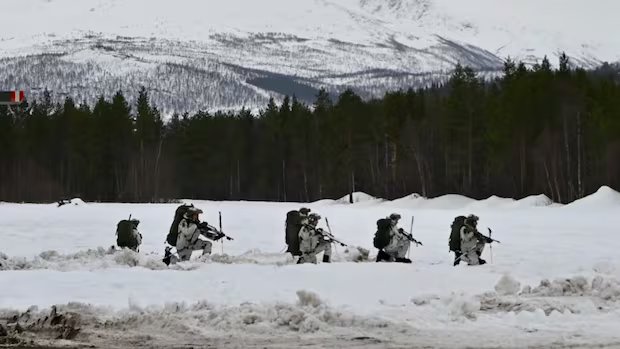
    “The Russians, they’re more capable, they are more organized than some of the traditional adversaries that we’ve faced over the last few years,” said Lt.-Col. Robert Girouard, the commanding officer of the Canadian Special Operations Regiment, which took part in NATO’s recently concluded Cold Response exercise in northern Norway and Finland.

    More than 30,000 allied troops, aircrew, sailors and civilians took part in the biennial drill, which aims to practise reinforcing northern Europe in the event of open conflict with Russia.

    In Bardufoss, a little slice of Norway above the Arctic Circle, German and Norwegian troops and U.S. marines waded through hip-deep snow, learning the challenges and limitations of the modern battlefield.

    A tank rolls over an icy terrain.
    A tank rolls over an icy terrain in Bardufoss, Norway. (Murray Brewster/CBC)

    During the exercise, Canadian commandos were dropped far behind enemy lines and Girouard said it was a new experience, even for troops versed in Canada’s Far North.

    “From a Canadian perspective, our Arctic is completely different,” Girourard said. “It’s much colder. There’s a lot of additional challenges in our own Arctic.”

    Finding ways to keep gear operating — especially delicate electronics — proved to be among the most eye-opening of issues.

    “When you get down to some of the temperatures like we have in our Arctic, some of these technologies are very difficult to operate,” Girouard said.

    “Batteries just don’t last as long … a commercial off-the-shelf drone like you saw today might be able to operate for 30 minutes in kind of more humid weather or warm weather. But in the cold, that might drop down to under 10.”

    The other major takeaway for Canadian troops was the difference in scale. Canada’s Arctic territory is vast and just getting anywhere is a challenge, whereas the battlefield in northern Europe — and the distances involved — were more compressed.

    Canada’s Far North covers nearly four million square kilometres, including 36,563 islands, increasing the surveillance and mobility challenges.

    The dilemma of distance is one of the reasons why the federal government recently chose to invest $35 billion in Arctic infrastructure — expanding old bases and building new ones.

    A man in a suit smiles as he shakes hands with a soldier in uniform.
    Prime Minister Mark Carney shakes hands with members of the Canadian Forces following an announcement to defend and transform Canada’s North in Yellowknife. (Adrian Wyld/The Canadian Press)

    The Canadian military’s operations commander, Lt.-Gen. Steve Boivin, said the larger northern footprint will allow for more exercises and more presence.

    “We’re planning towards a near persistent operational approach,” Boivin told CBC News. “I can’t say that we’re gonna be there 12 months a year, but we will operate for as much as we can — 10 to 11 months a year of operations in the Arctic, with some of our partners.”

    One of the biggest fears of allied planners is that adversaries — operating submarines or surface ships — in the Arctic could launch missiles or drones to attack targets in the south — using the Far North as a thoroughfare.

    The federal government has begun to invest in a $6-billion Arctic over-the-horizon radar system, but it still needs a presence on — and under — the water in the region.

    A program to buy modern submarines, capable of operating under the ice, has been accelerated, but the commander of the navy said planners will have to develop a concept of operations and procedures to do it safely.

    The first new boats are not scheduled to be delivered until the early 2030s. Even still, Vice-Admiral Angus Topshee said they will need specialized equipment for under-ice operations.

    WATCH | Top naval commander on Arctic defence:

    Defending distant, unsurveyed Arctic ‘more complicated,’ top naval commander says

    The navy’s top commander, Vice-Admiral Angus Topshee, spoke to CBC’s Murray Brewster about challenges that come with Arctic defence. ‘It’s always a difficult and dangerous environment because it’s distant, it’s not very well surveyed,’ Topshee said.

    “The first thing you need to do is you need an upward-looking sonar to be able to see the ice because the ice is a hazard to the submarine just as much as the bottom is,” said Topshee.

    Both the U.S. and the U.K. have extensive experience operating nuclear-powered boats under the ice of the Arctic and have a lot to teach Canadians, but Topshee said one of the biggest challenges they all face is climate change and how melting ice makes underwater navigation more difficult.

    “It’s always a difficult and dangerous environment because it’s distant, it’s not very well surveyed and everything else,” said Topshee. “So is it more dangerous? It’s more complicated. You have to be more careful.”




    Source link

    Related Posts

    What airlines are supposed to do when uncontrollable circumstances lead to flight disruptions
    Canada

    What airlines are supposed to do when uncontrollable circumstances lead to flight disruptions

    May 4, 2026
    Reeling from crisis, P.E.I.’s oyster industry hopes disease-resistant seed from U.S. helps
    Canada

    Reeling from crisis, P.E.I.’s oyster industry hopes disease-resistant seed from U.S. helps

    May 4, 2026
    This mother says Air Canada ignored refund plea for months after her child’s death
    Canada

    This mother says Air Canada ignored refund plea for months after her child’s death

    May 4, 2026
    FIFA World Cup: Everything (and more) you need to know about the 16 stadiums
    Canada

    FIFA World Cup: Everything (and more) you need to know about the 16 stadiums

    May 4, 2026
    Who won the lottery? Why you may never know the full name of some jackpot winners going forward
    Canada

    Who won the lottery? Why you may never know the full name of some jackpot winners going forward

    May 3, 2026
    Habs move on to 2nd round after Game 7 win against the Lightning
    Canada

    Habs move on to 2nd round after Game 7 win against the Lightning

    May 3, 2026
    Next Post
    IN DEPTHInsults and threats. Milei spread almost 1,000 messages against journalism on her social networks during EasterBy Martín Rodríguez Yebra

    IN DEPTHInsults and threats. Milei spread almost 1,000 messages against journalism on her social networks during EasterBy Martín Rodríguez Yebra

    POPULAR NEWS

    Justin Bieber fans flood Coachella festival for headlining show – Entertainment

    Justin Bieber fans flood Coachella festival for headlining show – Entertainment

    April 20, 2026

    Over 600 flee homes as Army, NPA clash in Negros Occidental

    April 21, 2026

    Ex-DPWH exec recalls P800-M ‘delivery’ to Zaldy Co 

    April 20, 2026

    Former PM Paluckas suspends party membership, to waive immunity over criminal probe

    April 24, 2026
    Pres. Ali challenges CARICOM to transform into health research powerhouse

    Pres. Ali challenges CARICOM to transform into health research powerhouse

    April 23, 2026

    EDITOR'S PICK

    Weekly Comic

    Weekly Comic

    April 12, 2026
    APNU pushes U.S support for bigger oil share for Guyana

    APNU pushes U.S support for bigger oil share for Guyana

    April 14, 2026
    Khrystyna Hornyak boasted of new sensual photos – black and white shots

    Khrystyna Hornyak boasted of new sensual photos – black and white shots

    April 28, 2026
    (LEAD) Coupang lobbying disclosure reports show activities involving White House, vice president, Congress

    (LEAD) Coupang lobbying disclosure reports show activities involving White House, vice president, Congress

    April 24, 2026

    Recent Posts

    • Trump says US will hike tariffs on EU cars and trucks to 25%
    • 5 things to say instead of ‘de rien’ when someone thanks you in French
    • This missile withdrawal weighs more heavily than the withdrawal of 5,000 soldiers
    • G7: György Matolcsy’s name comes up as soon as they start investigating the spontaneous privatization – but not like that

      © 2026 Agentially - Navigating shifting sovereignties and global risk .

      Welcome Back!

      Login to your account below

      Forgotten Password?

      Retrieve your password

      Please enter your username or email address to reset your password.

      Log In
      No Result
      View All Result

        © 2026 Agentially - Navigating shifting sovereignties and global risk .

        This website uses cookies. By continuing to use this website you are giving consent to cookies being used. Visit our Privacy and Cookie Policy.