Humeyra Pamuk, Dave Graham and Tala Ramadan
Updated ,first published
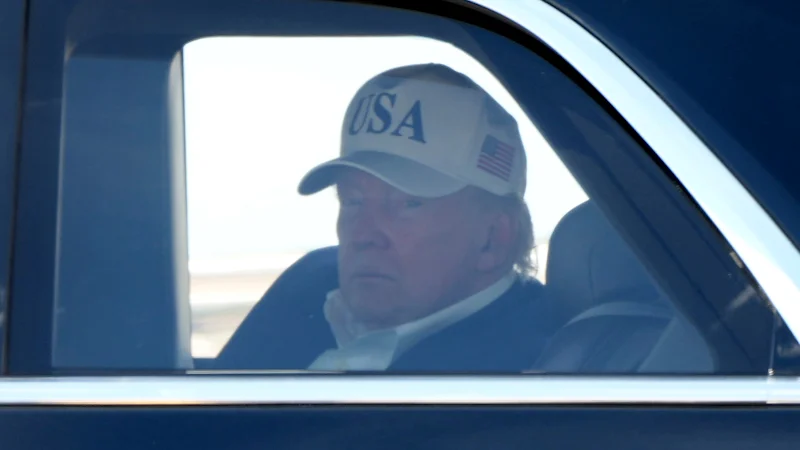
Buergenstock, Switzerland/Dubai: US President Donald Trump threatened to restart the war with Iran even as Vice President JD Vance met Iranian officials for the first talks under an interim peace deal, overshadowed by Tehran’s announcement that it had again closed the Strait of Hormuz.
The high-level talks in Switzerland, aimed at securing a permanent end to the war, ended early on Monday, with Iran’s foreign minister praising mediators Pakistan and Qatar, saying they had “delivered major progress”.
Posting on X, Abbas Araghchi said the first real test of the understandings reached would be a “de-confliction method” for stopping the fighting between Israel and the Iranian-backed militia Hezbollah in Lebanon.
There has been no comment from the US on the end of the talks, which were held in the Qatari-owned Swiss mountaintop resort of Buergenstock. Technical discussions between lower-level officials will continue there for the rest of the week.
Over the weekend, Iran, arguing that Washington had failed to meet its commitment to halt fighting in Lebanon, said it had closed the strait again and that the negotiations would not cover substantive issues such as Iran’s nuclear program.
“Iran must immediately stop their highly paid PROXIES in Lebanon from causing trouble. If they don’t, we’ll hit Iran very hard again, just like we did last week, only harder!!!” Trump said on Truth Social, apparently referring to Iran’s Hezbollah allies in Lebanon.
Fox News reported that Trump had gone further in an interview, saying he had told Iranian officials if they closed the strait, “you won’t have a country”.
“You won’t even make it back to your f—ing country … we’ll take over the rest of the country,” he said, according to Fox News. “We may take over the strait, if we have to. I’ll blow the s**t out of them.”
‘Things are always a bit messy’
Vance and other US negotiators, including envoys Steve Witkoff and Jared Kushner, Trump’s son-in-law, met Iran’s parliamentary Speaker and lead negotiator, Mohammad-Bagher Ghalibaf, and Araghchi for what Iranian state media said was about 80 minutes.
The vice president played down the impact of the conflict in Lebanon, saying progress had been made towards ending hostilities there. “These things are always a little bit messy,” he said.
Iranian state media said negotiations had entered a “difficult phase” and recessed after the “publication of an insulting message by the US president”. The Iranian delegation then met Qatari mediators and left the negotiating site, state media said.
“They would do better to be careful about their statements,” Ghalibaf said on X after Trump’s comments. “Our armed forces are prepared to respond to them in a different manner. They may keep talking, it is we who act.”
Iranian state media said the delegation had refused to return to talk directly with the US, but messages were exchanged through Qatari and Pakistani mediators, citing an informed source.
An official with knowledge of the talks later told the AP that the Iranian delegation remained engaged.
The diplomat, speaking on condition of anonymity to describe private discussions, said talks included clarifying what Iran meant by recent statements about the Strait of Hormuz.
Negotiators also discussed “mechanisms” to ensure the strait remained open and that a ceasefire in southern Lebanon was enforced, as well as “robust” discussions on the nuclear issue.
Even as Trump was threatening Iran, Vance told reporters that the US president had “asked us to turn over a new leaf to transform our relationship with the people of Iran”.
The warring sides did not pursue a joint photo opportunity at the talks. Before Vance made his remarks, Araghchi briefly walked into the room and embraced Pakistani Prime Minister Shehbaz Sharif, a mediator. Araghchi did not interact with Vance, who was at the back of the room.
Despite the announcement of a new ceasefire in Lebanon on Friday, there has been scant sign of an end to fighting there. Iran said on Saturday that, as a result, it had again shut the strait, whose closure for nearly four months caused the biggest disruption to global energy supplies in history.
US officials disputed that the strait was closed, but commercially available shipping data showed an immediate impact.
Trump said he agreed to last week’s memorandum of understanding to avert a global economic depression from high oil prices caused by the strait’s closure. Oil prices had tumbled over the past week to levels unseen since the war began.
Vance said before his departure that he hoped to make progress on the nuclear issue. But after Sunday’s talks, Iranian state media said Iran’s nuclear program had not been discussed.
Earlier, Iran’s Foreign Ministry spokesperson, Esmail Baghaei, said that since Washington had failed to guarantee a ceasefire in Lebanon, the meeting would cover only the implementation of the memorandum itself, not the substantive issues foreseen for the next stage.
The memorandum foresees 60 days of talks on issues such as curbing Iran’s nuclear program in return for the lifting of international sanctions. Before those issues are resolved, Iran expects to receive initial economic benefits, such as sanctions waivers and the unfreezing of blocked assets.
Sunday appeared to be the quietest day in Lebanon for some time, with no reports of major violence by nightfall, after two days of heavy Israeli strikes and fire from Hezbollah fighters on Israeli positions.
Reuters, AP
Get a note directly from our foreign correspondents on what’s making headlines around the world. Sign up for our weekly What in the World newsletter.