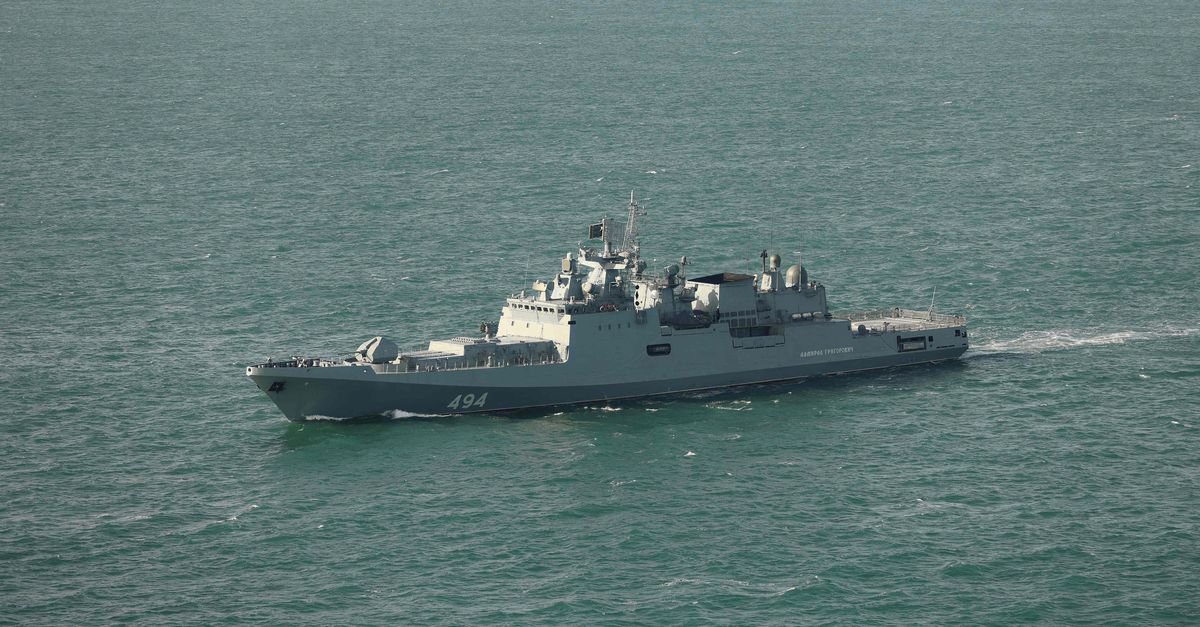
Was a collision imminent? Even in that case it is unprecedentedly excessive to fire warning shots, as a Russian warship did on Tuesday on the approach of a British sailing yacht in international waters in the English Channel.
It happened to Jane and Alan Kelvey, two sixties in their sailing yacht Bright Future were en route from the south coast of England to Cherbourg in Normandy, 23 miles (43 kilometers) from the Isle of Wight. When crossing the deep-water route for large sea shipping they approached the Russian frigate Admiral Grigorovich to within about 500 meters. Too close, according to the Russian crew.
An “unreal” experience, Jane Kelvey said Tuesday evening against BBC televisionafter arriving in Cherbourg. According to her, there had been no potential collision. Nevertheless, the frigate gave five blasts with the ship’s horn (“danger of collision”), after which the yacht changed course as a sign that it had seen the warship. According to her, the frigate then gave another five blasts, followed by “four or five shots with a gun.”
According to the Russian Defense Ministry, shots were fired from the frigate across the yacht’s bow as it came “dangerously close”, after the frigate had unsuccessfully tried to make contact via VHF radio and even shot off flares. According to the ministry, the crew of the Grigorovich had “acted in strict accordance with international maritime regulations.”
‘Engine gives way to sail’
According to the International Convention on Traffic Rules to Prevent Collisions at Sea (known as the ‘Collision regulations‘ or ‘Colregs‘), however, the main rule is that a motor ship must give way to a sailing ship. A warship has no special status.
There are exceptions to this. For example, a sailing ship that overtakes a motor ship must take evasive action itself. This also applies when a motor vessel cannot or has limited maneuverability, or when the motor vessel is fishing. A sailing ship may not hinder a motor ship sailing in narrow waters or in a narrowly demarcated so-called traffic separation system (TSS). And as soon as a sailboat (also) sails on the motor, it is considered a motor ship itself, whereby different priority rules apply.
Kelvey: “As far as we are concerned, there was only an incident when shots were fired,” she said. According to her, the shooting was “completely unnecessary.” She said she reported the incident as “a hazard to navigation,” as required.
Details about the situation are lacking. There is no TSS at that location in the Channel. It is unknown whether the sailing yacht also sailed on motor. In any case, the rule of ‘good seamanship’ always applies, which stipulates that ships must do everything they can to avoid a collision ‘early and unequivocally’, such as keeping a permanent lookout and not ‘enforcing’ their own priority, thereby creating a dangerous situation.
According to the BBC, the incident happened in foggy weather conditions.
Shadow Fleet
Although the British Navy called it “an isolated incident”, it is difficult to separate it from the entry of a Russian shadow fleet tanker into the Channel. Sunday by British soldiers.
During that operation, with helicopters and British naval vessels, the Russian frigate was in the area. The Grigorovich has been sailing in that sea area since April with the aim of escorting tankers carrying Russian oil. A Russian supply ship periodically supplies the Grigorovich with fuel.
According to the British, the boarded tanker, Smyrtos, at that time flying the flag of Cameroon, was transporting oil that is subject to Western sanctions against Russia. According to news channel Al Jazeera At least six other tankers from the shadow fleet turned back immediately after the operation.
The Grigorovich was shadowed on Tuesday by HMS Mersey, a British patrol ship. Another patrol ship, HMS Tyne, sent a boat to the sailing yacht to see if the crew was safe and to gather information.
Tracking Russian naval vessels puts a strain on the British Navy, which is facing a ship shortage. The Russian shadow fleet consists of about 700 ships. Russia acknowledged in April that it has tankers carrying Russian oil escorted by its navy. “If necessary, further measures will be taken to secure shipping and protect national interests in international waters,” Nikolai Patrushev, an adviser to Putin, said at the time.
Also read
Sweden’s appeal to the Netherlands and others: tougher approach to the Russian shadow fleet
:format(webp)/s3/static.nrc.nl/wp-content/uploads/2026/06/15182953/150626BUI_2034487022_VK.jpg)