EDUCATION
Realities facing two junior high schools in National Capital District may well be a story retold around the country
The general situation at junior high schools may be similar to a loud tribal chief announcing a big feast in the village square without first doing a realistic mental calculation of the produce in the gardens and pigs in the pens.
On the day the whole tribe turns up but then many leave unhappy as there isn’t enough to go around. And those left to bear the brunt of the tribe’s collective disappointment are the chief’s servants tasked with the distribution of food items.
Hold onto that thought as we visit two junior high schools in National Capital District.
EVEDAHANA, over at the 9-Mile area and Ororo in the June Valley area are two of junior high schools in the capital making do with whatever resources they have. The others who might be faced with similar trials are New Erima, Bavaroko and Kaugere.

Throughout the country, each district would have by now at least one junior high school already in operation.
With their upgraded status these schools now require secondary-level teachers to be on the same campuses with primary school colleagues.
Without any meaning investment the present issues could worsen from 2028, when the Grades 8 and 10 examinations will no longer be used to filter students continuing to years 9 or 11.
It is all part of the Government’s 1-6-6 education structure. The thinking behind it is to allow every pupil enrolling at elementary level to go all the way through to Grade 12 – and given a chance at securing tertiary level education or sufficient life skills for life.
Leap of faith
But without available classrooms, curriculum materials and teachers, the decision to upgrade these schools is a huge leap of faith.
Faith in parents or someone else putting up the money for standard infrastructure, and faith in government itself providing the required materials, buildings and sufficient numbers of trained teachers and funded teachings positions.
There are cases where some measure of preparation has taken place but the move to upgrade schools appears to have been driven largely by the rationale of student numbers or to satisfy a government policy.
Annually, the numbers of ‘pushouts’ keep rising and that required urgent government intervention. This policy is an answer to that. And it is commendable – but the question is about preparedness.

Student numbers
The number of students pushed into them are way beyond the ability of any teacher to deliver a day’s lessons and go home satisfied.
A class of around 45 pupils would be about right for a teacher to manage but in both schools visited class sizes are anywhere between 60 and 110 students.
And all these young people are looking to the one adult to guide them in their learning that will shape their lives in the future.
Evedahana JHS
First, a glimpse of the situation at Evedahana. There are a total 1,523 students (Grades 7 to 10). The biggest classes in each grade are as follows: 7C with 88; 8A with 71; 9C with 105 and 10A with 109.
Four classrooms have no desks and students are sitting on the floor. One Grade 9 class and one Grade 10 class sit back to back on the floor of a classroom hall that is yet to be partitioned.
When the junior high school began operations in 2024 there were 14 classes; in 2025 there were 16 classes; in 2026 there are now 20 classes.
In 2025 there were 102 Grade 8 students selected for Grade 9. Those students had scored at least 80 out of a possible 150 marks in the national examination. NCD Education pushed in an additional 264 from other primary schools to Evedahana. Those students scored between 55 and 79 points out of 150.

Immediate needs
School principal Jasson Armani, who was posted there from La Salle Technical Secondary School is leading a team of dedicated teachers who are trying their level best to deliver reasonable outcomes.
The school’s immediate needs are classrooms, ablution blocks, science and computer labs, a library, a staff room and administration block. Plus – some time in the not too distant future – there must be a fence running across the school ground to keep the ‘little ones’ from needlessly mingling with and disturbing high schoolers.
It will take between K8 and K13 million over a number of years to bring the school infrastructure up to acceptable standards, Armani says.
Parental support
With the tuition fee-free (TFF) education policy, schools are permitted only to charge parental support fees for specific projects. At Evedahana, the school board floated the idea of parents paying between K500 and K1,200 per child but settled for K300 per child.
If all 2,000 parents paid their contributions the school would get at just over half a million kina, money that is badly needed.
At today’s costs, to get a four-in-one classroom block with office spaces included would cost at least K800,000. It means therefore the school will build over a long time to get to that stage where it can have all necessary buildings erected.
A new eight-in-one classroom block funded by the National Capital District Commission is currently under construction. It will ease some of the overcrowding as seventh and eighth graders will make room from grades nines and 10s to move in. A similar classroom building is also going up at Ororo Junior High School where class sizes are no different to those at Evedahana.
Evedahana currently has 15 staff but needs a further 15. The school has applied for these 15 new positions and the Teaching Service Commission has approved and created those positions.
However, the positions will only become available in 2028 so it means that next year, the school will have to manage with the existing 15 teaching positions.

Head boy speaks out
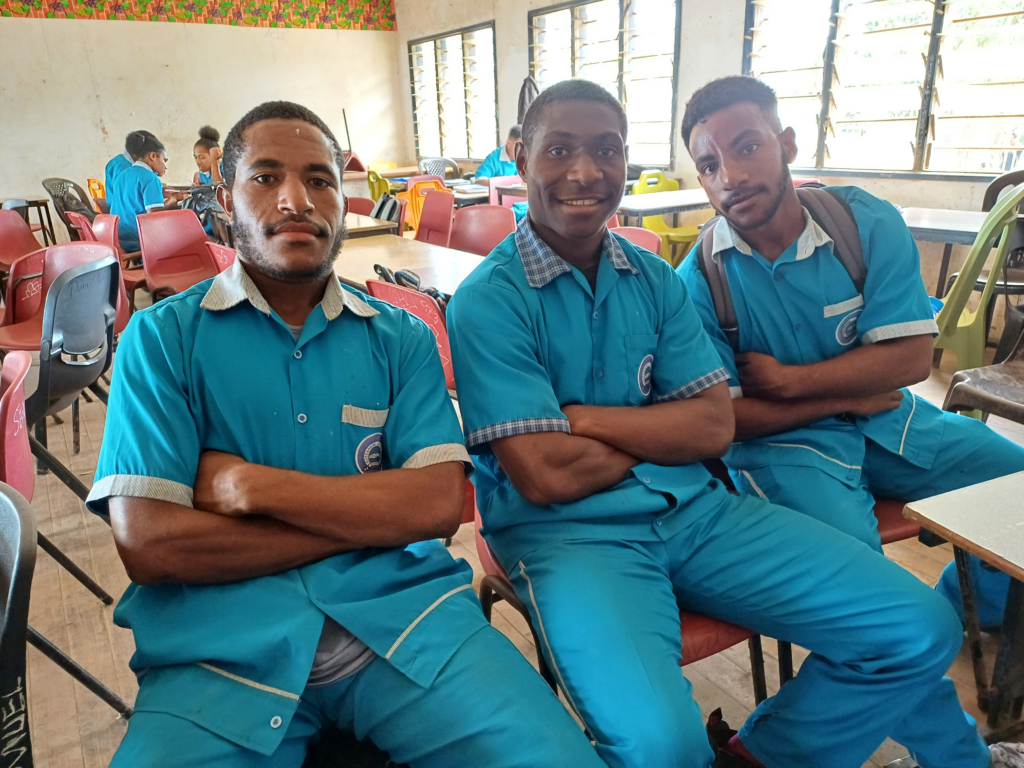
Head boy Elijah Akesingke says there are way too many of them (99) in their 10B classroom. They are sitting four to a desk.
“We started with 121 but some went to another class. Even with 99 it is still overcrowded and there is a lot of noise. Teachers do not teach very well because there are too many of us.”
In Port Moresby’s dry period, the school campus is a patch of dusty brown earth. When it rains classes are suspended as there is just too much mud splatted all over classrooms.
A teacher’s lament: Quantity vs quality
Principal Armani remembers better days in his 16-year career.
“Teaching a class of primary or high school students today is like delivering a lecture. Students have different learning abilities; some will capture concepts quicker than others. Those others need teacher guidance and assistance. With today’s class sizes, such assistance is difficult to provide.
“We get satisfaction from the service we provide our students, and their success mirrors our success. They take a piece of us with them,” Armani says.
His deputy Malcolm Dangi says with the switch from outcomes-based education (OBE) to the standards-based curriculum (SBC), the teachers’ workload has become heavier.
“Squeezing all the content into 10 weeks (each term) is difficult,” Dangi says.

TFF funding
It is an often repeated cry of school administrations that the (TFF) funding alone is hardly enough to run schools. At Evedahana, the school board says funding was a lot more reliable a few years ago than it is today.
When Evedahana was only a primary school, it received somewhere up to K500,000 per term. That figure has gone down to between K80,000 and K120,000 today.
Due to the uncertainty of funding, the school had to get materials on an understanding with service providers to prop up operations. Those ‘gentlemen’s agreements’ have accumulated debts that will have to be paid out of TFF funding as and when it comes from Waigani.
Ororo Junior High School
Over at Ororo, Mathematics senior subject master Igel Laka and Personal Development subject master Caroline Peter say their story is no different.
Ororo Junior High School started in 2023 and held its first Grade 10 graduation in 2025.
There are three Grade 10 classes holding 60-plus students each.
The Grade 9 classes have 100-plus students each, Laka revealed.
Laka and Peter were interviewed in a staff room that the high school and primary teachers have to take turns in using for now.
When the school started operations, there were 13 teachers but three of those were there on borrowed positions from other schools. This year staff numbers have gone back to 10. More teaching positions are needed.

SBC materials
Laka and Peter revealed that the education department has not been able to provide adequate teaching aids and curriculum materials to work with using the standards-based education.
“We spend our own money to browse the internet and download teaching resources to teach,” Peter said.
Government’s policy ideas may be commendable and workable but it must plan well.
“The Government must first build infrastructure and create teaching positions. Then it can adequately implement, its education policies,” Peter said.

Conclusion
The situation at Evedahana and Ororo is perhaps a clear enough picture of what is happening at junior high schools across the country. The cry for better preparation and planning rings loud and clear.
Some schools fare a little better than others but generally, teachers and school boards want to be prepared sufficiently to take on the added classes and responsibilities.
The situation might get worse before it gets any better and the fruits of any investment realised. These might be only teething problems and with the right attitude from all involved, schools like Evedahana and Ororo can catch up with the rest.
The Government has spoken about education reforms without getting fully ready. Without preparations in infrastructure, curriculum materials and teacher numbers one of two possible outcomes from junior outcomes can be expected.
Either teachers and students, in these schools would defy the odds stacked against them and succeed or they would be overwhelmed.
The resilience and a touch of innovation demonstrated by teachers at the schools visited and most likely their colleagues around the country in doing their best to provide an education to all deserving young people is reason enough for some stubborn hope going into the future.
Note: We tried unsuceessfully to get comments from the NCD Education Services.