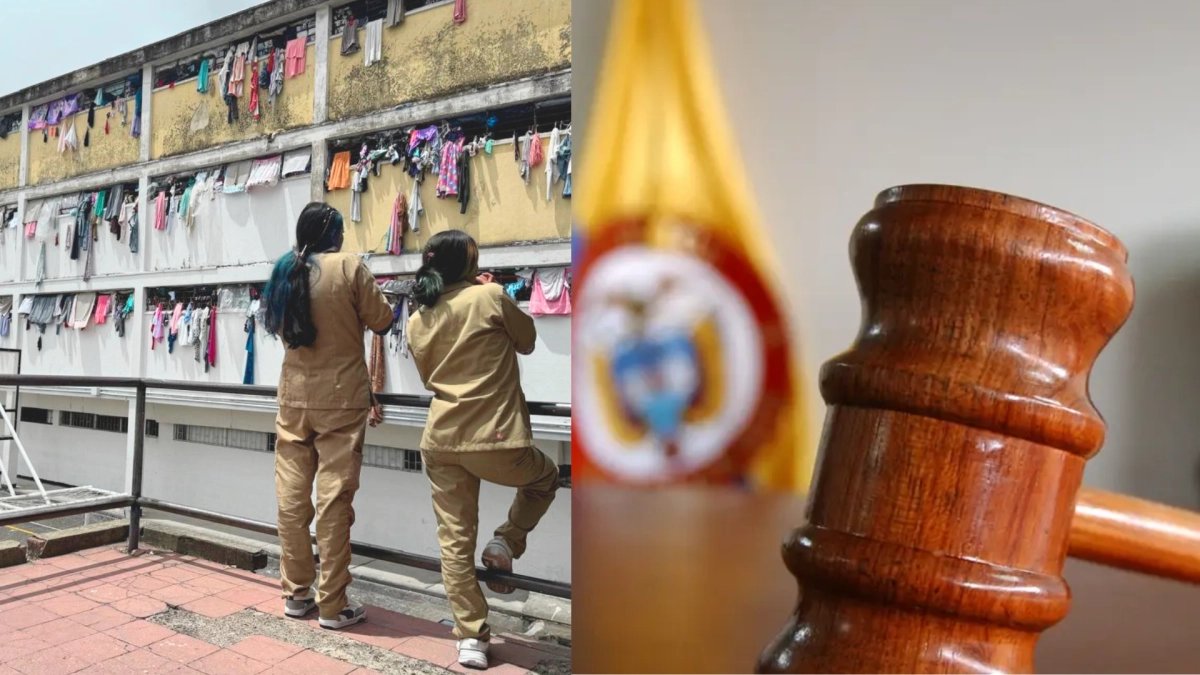
After three yearsthe implementation of the Public Utility Lawa rule that allows mothers head of household deprived of liberty replace prison with social workadvance to slow pace.
According to figures known to the Constitutional Court within a recent guardianship sentencesince the entry into force of the law, in 2023have been uttered 204 favorable decisions that have benefited 201 women throughout the country. It is a reduced number compared to the estimated universe of between 2,000 and 4,000 potential beneficiaries.
If you look at the map, in addition, the application of the benefit presents strong territorial imbalances. Antioquia concentrates 44% of favorable decisions, followed by Santander, with 14%, and Cundinamarca, with 11%. In Bogotadespite being one of the districts with the largest female population deprived of liberty, hardly any 14 decisions of this type.
Likewise, the available data show a significant concentration by criminal typologies. He 68.37% of benefits have been granted in cases related to trafficking, manufacture or possession of narcotics; 14.88% for theft; 6.04% for conspiracy to commit a crime; and 3.72% for manufacturing, trafficking or carrying weapons.
In the judgmentauthorship of Judge Jorge Enrique Ibáñezthe Court warned that this panorama suggests that the measure is not operating with the territorial or material breadth that would be expected from a tool conceived as a affirmative action with a gender and restorative approach.
Likewise, the high court drew attention to the absence of consolidated figures on the application of the standard.
As he pointed out, there is no complete statistical record that allows you to know how many requests have been submitted, how many have been denied, how many are still pending decision or how long do judges take in solving them.
There is also no comprehensive public monitoring system that allows reconstructing the behavior of the benefit in all its stages.
El Buen Pastor Prison, Bogotá. Photo:Milton Díaz/El Tiempo
For him high courtthat lack of traceability makes it difficult to create a detailed diagnosis on the implementation of the law, which, consequently, prevents evaluating whether the mechanism is being applied evenly throughout the country and if it is really fulfilling the purpose for which it was created.
The difficulties that the judges encountered
The ruling also includes findings presented by Dejusticia, Free Women and the University of Essexwhich identified conceptual, evidentiary, procedural and institutional management obstacles in the application of the Law 2292 of 2023 (Public Utility Law).
Among the main problems appear differences in interpretation of concepts like “female head of family” and “marginality“; difficulties gathering evidence sufficient to prove the vulnerability conditions of the applicants; tensions between the judges of knowledge and the judges of execution of sentences; and problems derived from judicial congestionthe limited social assistance and the difficulties in getting places where women can provide social work.
In the opinion of the Court, the sum of these factors is behind the low benefit application. “There are indications of divergent interpretations and evidentiary requirements that, in certain contexts, end up moving away from the constitutional purpose of the rule“he noted.
The rules set by the Court
Given this panorama, the Court decided to establish minimum parameters for unify the application of the Public Utility Law.
Among the established rulesspecified that the judges cannot demand for a woman to prove that crime was his only alternative to survive. The law requires try a relationship between behavior and vulnerable conditions that affected the home maintenancebut not to prove a situation of absolute inevitability.
He also clarified that the home maintenance don’t just guarantee food or immediate survival goods, but understand expenses as rent, public services, transportation, health, education, clothing and child care.
Therefore, it is not valid to discard automatically the marginality because the assets involvedfor example in theft, were not intended to cover immediate basic needs.
The Court added that the how the crime was committed nor does it exclude by itself the existence of structural conditions of vulnerability and remembered that the evidentiary analysis must be comprehensivejointly valuing elements such as economic precariousness, labor informality, the absence of support networks or official poverty records.
Likewise, he reiterated that the judges cannot impose documentary requirements impossible to meet for women deprived of liberty.
El Buen Pastor Prison, in Bogotá. Photo:Sergio Acero Yate/ El Tiempo
What does it mean to be a mother and head of the family?
The ruling also dedicated a special section to specify how the status of mother or woman head of family.
The Court clarified that the existence of temporary family support does not eliminate automatically that condition. The relevant thing is to establish who structurally exercised the head of household and assumed the main economic, emotional and social responsibilities before deprivation of liberty.
For this reason, he warned that judges cannot limit themselves to examine how the family was organized after the capture, nor to demand that the children be in a situation of absolute abandonment for recognize the benefit.
Finally, he recalled that the purpose of this mechanism It is not favoring the convicted person or relativizing the sanctioning capacity of the State. Its constitutional purpose is prevent the execution of the sentence from producing disproportionate consequences about boys, girls and other dependent people who did not participate in the criminal conduct, in development of the principles of material equality, reinforced protection of children and affirmative actions with a gender perspective.
The measure was ordered by the Constitutional Court. Photo:Courtesy Constitutional Court
The case that led to the ruling
The case that gave rise to this ruling was that of a woman sentenced to more than 4 years in prison by attempted qualified and aggravated robberywho sought to access the benefit to be released through the social work.
Mother of three children and detained since May 2023the woman argued that she had grown up in a context of high vulnerability marked by family abandonmentthe street situation, the consumption of psychoactive substances and the early motherhood.
Furthermore, he maintained that before his capture there was resumed direct and permanent care of their childrenwho remained under the maternal grandmother care after his admission to jail.
However, both Court 030 for the Execution of Sentences and Municipal Criminal Court 085 of Bogotá they denied the benefit considering that he did not accredit two of the requirements required by law: his status as mother head of family and the existence of a link between the crime for which she was convicted and conditions of marginality that affect the maintenance of your home. It was that decision that ended up reaching the Constitutional Court via review. And the high court decided to review the case and set new rules on the application of this mechanism.
Sara Valentina Quevedo Delgado
Justice Editorial