-
By Hollie Younger / Staff writer, with CNA
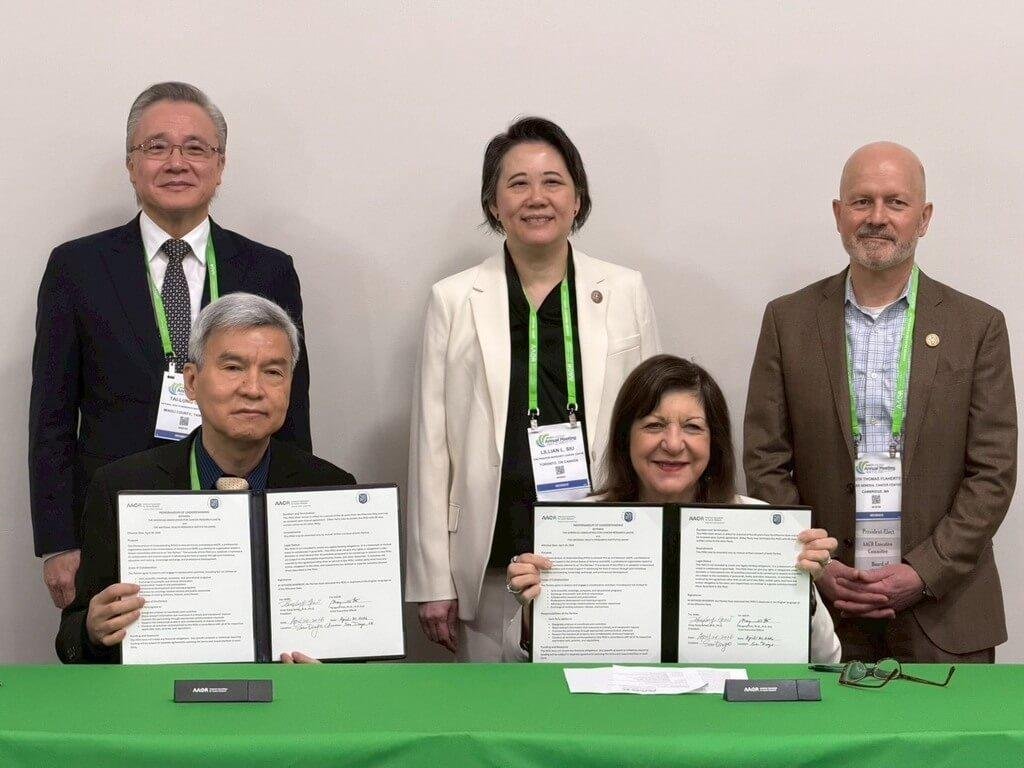
The National Health Research Institutes (NHRI) yesterday signed a memorandum of understanding (MOU) with the American Association for Cancer Research (AACR) to deepen Taiwan’s international participation in global cancer research and treatment.
The MOU was signed yesterday morning by NHRI president Sytwu Huey-kang (司徒惠康) and AACR CEO Margaret Foti at this year’s AACR Annual Meeting in San Diego, California, which began on Friday and runs through tomorrow.
The world’s first and largest cancer research organization, the AACR was founded in 1907.
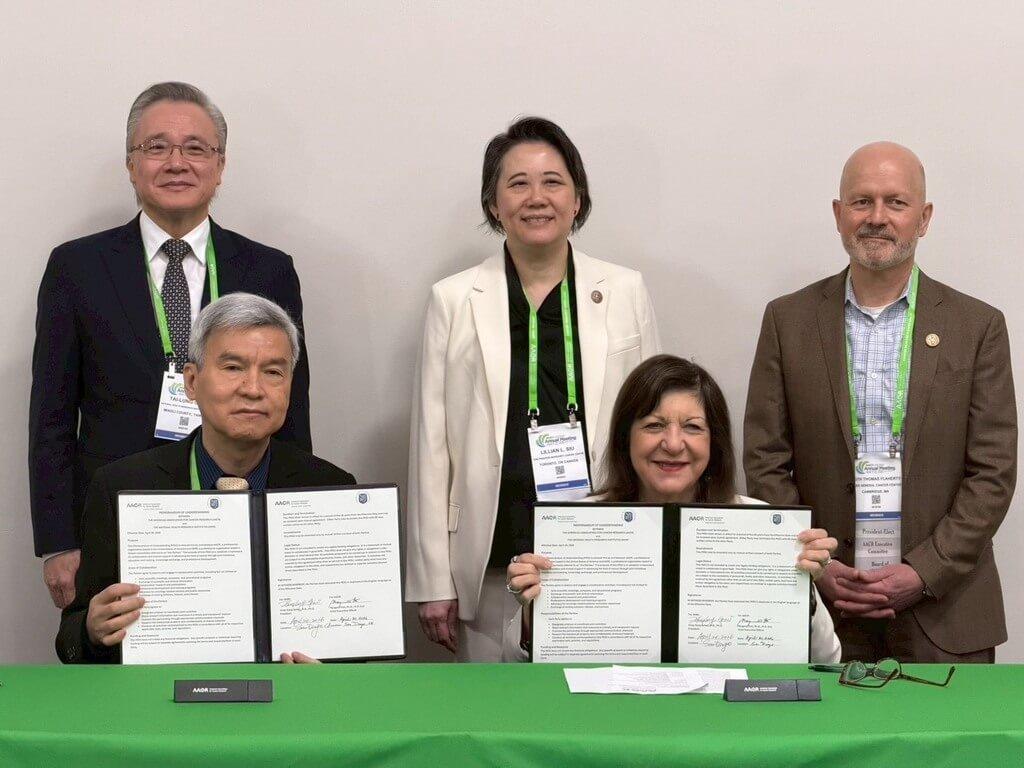
Photo courtesy of the National Health Research Institutes
It brings together scientists, clinicians and healthcare professionals from around the world to prevent, treat and cure cancer while improving the quality of life for cancer patients.
The MOU outlines key areas for cooperation under a five-year partnership to advance cancer research, including through the use of artificial intelligence applications, immunotherapy and genomic analysis.
The areas of cooperation include improving the international competitiveness of young researchers jointly organizing international conferences, symposiums and training programs, and improving digital information sharing of scientific and clinical data.
Both sides pledged to advance multinational collaborative research projects and academic publications, provide professional development training programs for young researchers and clinicians, and advocate for cancer-related policies.
The MOU also aims to facilitate exchanges and visits for academics, researchers and trainees.
Foti said that she was deeply impressed by Taiwan’s vibrant academic community during her visit many years ago to Academia Sinica.
Taiwanese researchers are playing an increasingly influential role on the international stage, she said, adding that the AARC has more than 600 members from Taiwan, accounting for almost 10 percent of its Asia-Pacific membership.
Sytwu said that the NHRI’s first research unit was the National Institute of Cancer Research, which has since built partnerships with major domestic clinical centers to bolster Taiwan’s clinical research and align it with international standards.
As the NHRI marks its 30th anniversary, the MOU highlights Taiwan’s important role in global cancer research and reinforces its commitment to translating cutting-edge scientific discoveries into clinical applications, he added.