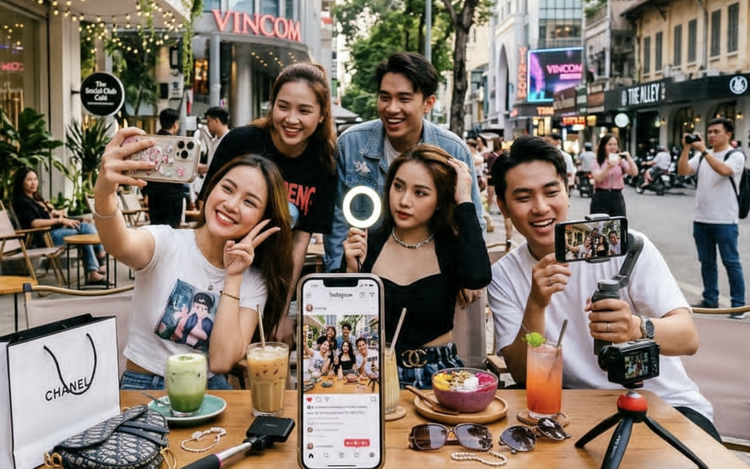
In Vietnam, for many young people, showing off on social media has become a hobby, and even a hard habit to break. Photo: AI
For many young people, social media has become an inseparable part of daily life.
They see sharing these things as a way of expressing themselves, but the line between sharing and showing off can sometimes be very thin.
A subtle but widespread pressure has taken root.
Many young people feel compelled to demonstrate that they are doing well – successful, stable, and living a life worth admiring.
When friends post travel photos, others feel the urge to do the same.
When someone shows off a new car, they also want to prove that they are not inferior.
Social media gradually transforms into a stage where individuals perform carefully edited versions of their lives, selecting only the most flattering scenes for public view.
The ordinary, the difficult, and the imperfect are often left behind.
What remains are highlights – moments polished for attention and approval.
Yet real life rarely resembles such a continuous highlight reel.
A single photograph may take minutes to capture, but it can follow hours of preparation.
A luxurious trip shared widely online may represent years of saving, or even financial strain that is never visible in the post itself.
As young people are repeatedly exposed to these idealized images, comparison becomes almost inevitable.
Questions begin to surface quietly but persistently: ‘Why haven’t I traveled as much?,’ or ‘Why don’t I own a house or a car yet?.’
These comparisons often arise even when one’s actual life is stable, meaningful, and progressing at its own pace.
Some young people also admit that showing off on social media sometimes comes from a need for recognition.
A posted photo that receives many likes and positive comments can bring a sense of happiness, and even boost self-confidence.
However, if happiness depends too much on the attention of others, it can easily become fragile.
When a post does not receive the attention expected, disappointment can follow.
The problem is not social media itself, but the way it is used and the weight placed on its responses.
At its core, social media is simply a tool which can connect people across distances, facilitate learning, and amplify positive stories.
However, when it becomes a platform for comparison and silent competition, it shifts from a tool of connection to a source of pressure.
Some young people are gradually realizing this.
Instead of only posting glamorous moments, they have begun to share everyday stories: a tiring day at work, a professional failure, or honest thoughts about life.
These kinds of posts sometimes receive even more empathy, for they are closer to real life.
In reality, every individual moves through life at a different rhythm.
Some achieve success early, while others take longer paths to build careers or stability.
Some are drawn to travel and exploration, while others prefer simplicity and routine.
No two paths are the same.
As such, instead of trying to display a perfect life online, it may be more important to live authentically in one’s own life.
When young people are no longer overly concerned with appearing ‘successful’ in the eyes of others, they will have more energy to focus on what truly matters.
Social media can be a place to share joy, but it should not become a measure of a person’s worth.
Real life, with each individual’s efforts and experiences, is what truly determines who we are.