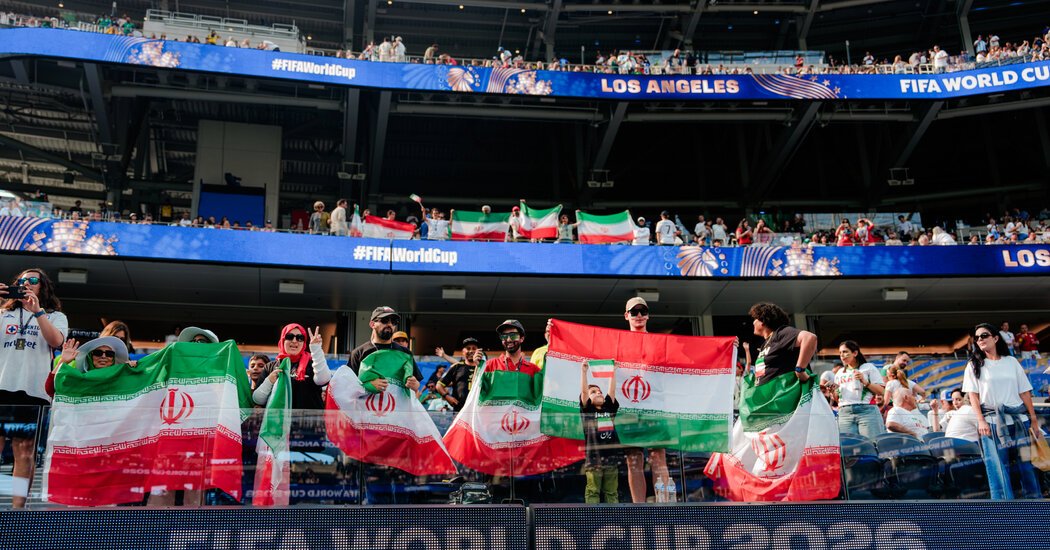
How do you get countries that hate each other, or are actively fighting, to play soccer? That question was thrust at FIFA, the sport’s governing body, when the United States and Israel started a war with Iran.
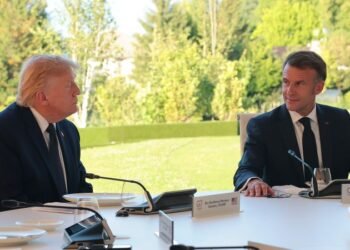
For weeks, it seemed improbable that the Iranian team would travel to the United States. President Trump said in March that, while the Iranian players were welcome to compete, he did not think they should “for their own life and safety.”
After months of uncertainty that included visa delays and the relocation of its base from Arizona to Tijuana, Mexico, Iran finally began its World Cup campaign in California on Monday — only a day after Mr. Trump announced a preliminary deal to end the war.
This is hardly the first World Cup to grapple with fallout from wars. The 1942 and 1946 tournaments were not held at all because of World War II. Here’s a look at some of the others that were haunted by conflict:
The “Soccer War” (1969)
The relationship between Honduras and El Salvador had long been deteriorating for a host of reasons, including economic migrants and border disputes. Then, in the summer of 1969, the Central American neighbors found themselves facing each other in knockout qualifiers for the 1970 World Cup.
Honduras won the first, at home, and El Salvador the second. There was rioting after both matches. Hoping to avoid more unrest, the organizers moved the decisive third match to Mexico, a neutral venue.
On the day of that match, El Salvador severed diplomatic ties with Honduras, which followed suit the next day. El Salvador won 3-2, and eventually made it to the World Cup.
Within weeks, the two countries were at war. The fighting lasted just over four days, and more than 1,000 people, mostly civilians, were killed. While sports had little to do with the conflict, the unrest around the World Cup qualifiers led many to call it the Football, or Soccer, War.
Mauricio “Pipo” Rodríguez, who scored the winning goal for El Salvador in the third qualifying match, said in a 2019 BBC interview that soccer was not the trigger. “The war would have happened with or without that goal,” he said.
The Falklands War (1982)
The 1982 World Cup featured three nations of the United Kingdom — England, Scotland and Northern Ireland — as well as Argentina. Just over two months before the tournament was scheduled to begin, a longstanding dispute over the Falkland Islands in the Southern Atlantic exploded into a deadly war between Britain and Argentina.
Such was the anger toward Argentina that Britain’s sports minister, Neil Macfarlane, urged the cancellation of all sporting contacts with the country. There was still the possibility of U.K. teams facing Argentina in the World Cup, and a British government committee considered whether to withdraw from the tournament. Mr. Macfarlane told Prime Minister Margaret Thatcher that some players felt “revulsion” at the idea of playing in the same tournament as Argentina, according to government papers released decades later and reported by the BBC.
The World Cup began without any teams pulling out. At the opener, Argentina’s supporters tossed thousands of pieces of paper into the stadium that said the Falklands belonged to Argentina. But much like the tensions ahead of the 2026 World Cup, there was a breakthrough just as the tournament began: Britain announced the surrender of Argentine forces in the Falklands on June 14.
The hostility bubbled up again four years later at the 1986 World Cup, which Argentina won — led by the superstar Diego Maradona. On the way to the title, Argentina defeated England in the quarterfinal.
“Of course, before the match, we said that football had nothing to do with the Malvinas War but we knew a lot of Argentinian kids had died there, shot down like little birds,” Mr. Maradona wrote in his autobiography, using the Spanish name for the islands. “This was revenge.”
U.S.-Iran Face Off (1998)
The political tensions around Iran this year have echoes of the 1998 World Cup, where it competed in the same group as the United States.
The countries had severed diplomatic ties after Iran’s Islamic Revolution of 1979. And in the 1990s, anti-American sentiment had grown in Iran after the U.S. government imposed sanctions, accusing it of sponsoring terror groups and pursuing nuclear weapons.
At the U.S.-Iran match in Lyon, France, activists opposed to Iran’s government staged a protest with the banners and T-shirts of an opposition group — just as tournament organizers had feared they would.
But the contest itself was played in good spirits. The American and Iranian players shook hands before the match and posed together for photos. The Iranian team also handed the Americans white flowers, symbols of peace.
Iran won 2-1 that day, sparking joyous celebrations back home. Thousands took to the streets in Tehran, and the government framed the win as a victory over one of Iran’s greatest enemies.
“Tonight, again, the strong and arrogant opponent felt the bitter taste of defeat at your hands,” Ayatollah Ali Khamenei, Iran’s supreme leader, said in a statement on state television.
Ayatollah Khamenei was killed on Feb. 28, the first day of the U.S.-Israeli war.