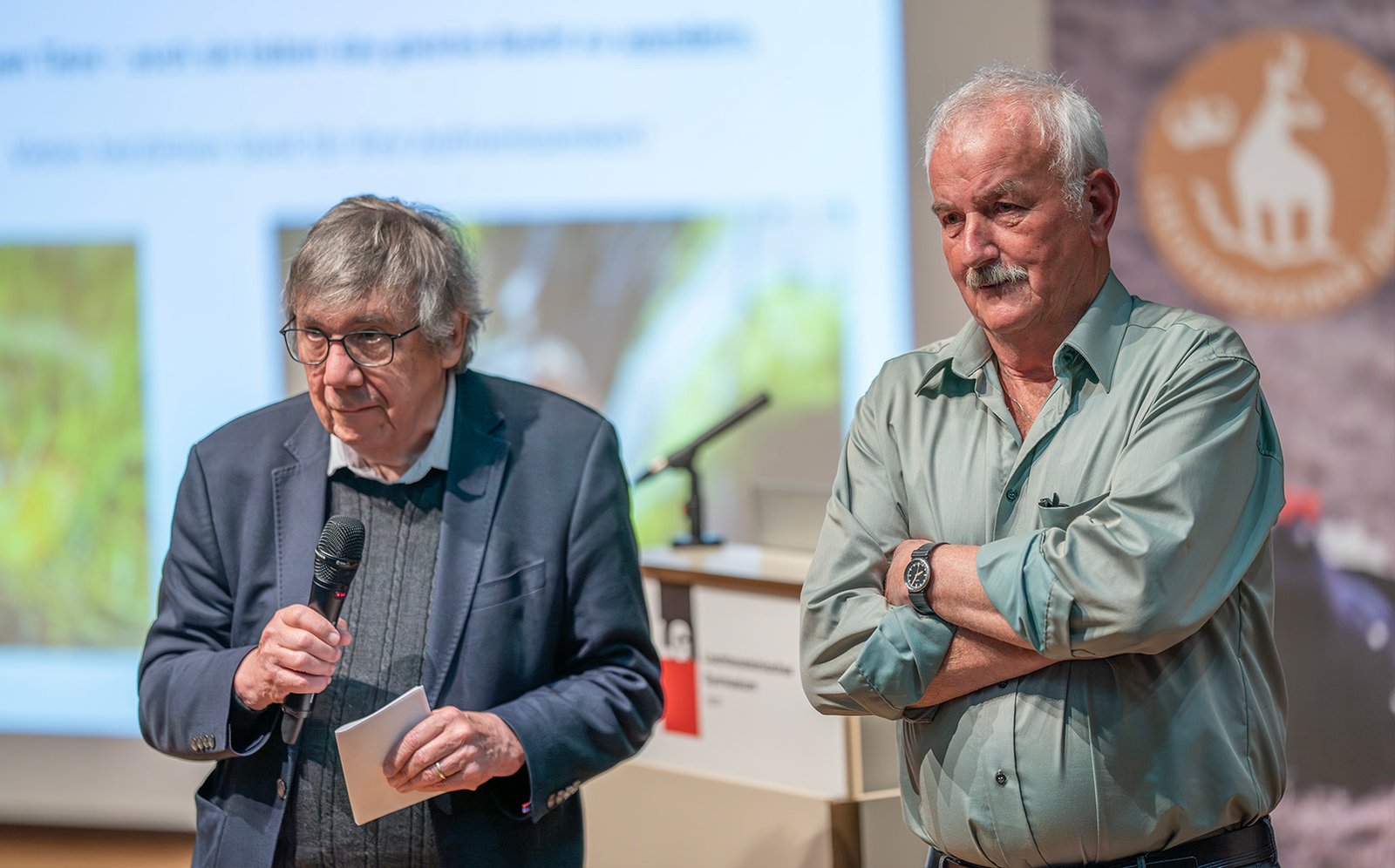
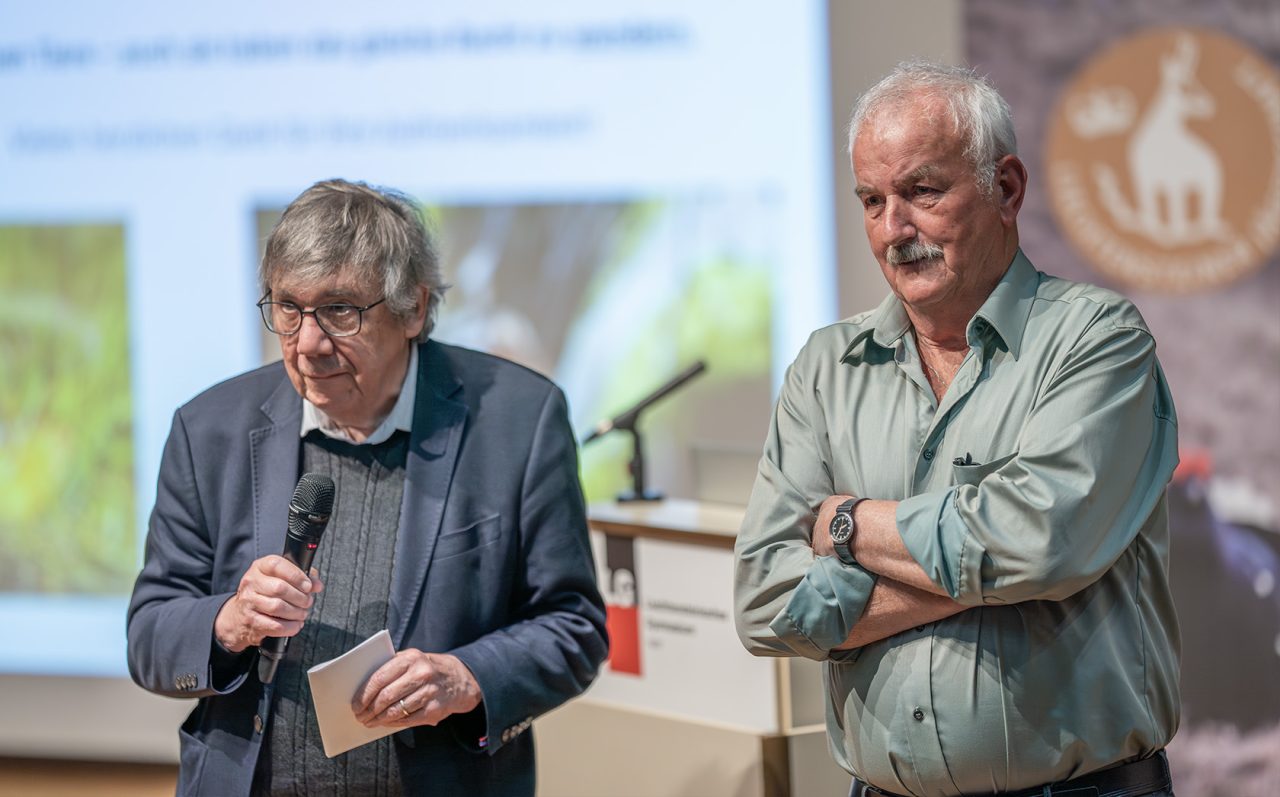
Josef Biedermann and Peter Eggenberger | Photo: Gregor Meier
At a well-attended evening lecture in the auditorium of the Vaduz high school, two experts reported on their many years of practical experience on wildlife corridors and road crossings. The event was organized by the Liechtenstein-Sargans-Werdenberg Botanical-Zoological Society, the Order of the Silver Break and the Liechtenstein Hunters’ Association – and the topic has direct Liechtenstein relevance: In December 2025, the government decided to move forward with the planning of a wildlife underpass on Feldkircher Strasse in Schaan.
Canton as coordinator – and the challenge of land ownership
The first speaker to speak was Kevin Simmler, who is responsible for coordinating wildlife protection measures at the cantonal level. He explained that the federal government is developing the strategic guidelines for wildlife corridors, but the cantons are responsible for implementation locally. Communities, hunters, nature conservation associations and landowners are indispensable partners – because without their involvement, measures can hardly be implemented. The question of hedges as guiding structures is particularly sensitive: Such structures are crucial for wild animals to approach and use a corridor. However, according to Simmler, negotiations with farmers are often difficult because hedges limit the area that can be used for agriculture.
There are two wildlife corridors of national importance in its reporting area. In the southern section – the Wartau corridor – a wildlife overpass over the motorway is planned, the implementation of which is scheduled for 2028. A second corridor in the northern area is also being planned; A transfer is also planned there.

Wildlife warning systems as a supplementary instrument
So-called wildlife warning systems took up more space in Simmler’s lecture. These systems detect wild animals along a road and warn drivers with beacons before an animal enters the road. Such a system has been in operation on a route in his area of responsibility since last summer – since then there has not been a single accident involving wildlife on this route. Simmler, however, urged caution: the time of experience is still too short to draw reliable conclusions.
A study on four routes with wildlife warning systems showed that the speed of vehicles decreases when the system is triggered. A direct, measurable reduction in wildlife accidents was not clearly proven statistically, but the system slowed down traffic on all four routes – and slower vehicles meant significantly less damage in the event of a collision, including for the driver. Data from the canton of Aargau showed wildlife accident numbers of 0 to 4 per year on several routes with wildlife warning systems – and that was previously significantly higher.
An exception is a route that, despite the system, has a relatively high number of accidents: the vegetation there is too high, which affects both the visibility of the warning signal for wild animals and the reaction time of drivers.
Three measures – no patent solution
Overpasses, underpasses and wildlife warning systems – all three variants have specific advantages and disadvantages, says Simmler. Wild animal transfers are generally better accepted by the animals, but are expensive and have a significant impact on the landscape. Underpasses fit more discreetly into the terrain and could work just as well – local conditions are crucial. Wild animal warning systems are comparatively cheap and can be moved in an emergency, but do not offer a long-term guarantee. Simmler deliberately did not want to give a final conclusion as to which variant was the best: “I’ll just show you the advantages and disadvantages.”
For him there is no question that obstacles to wild animals – such as unnecessary fences – must be consistently dismantled, habitats must be improved and everyone involved must be included in the planning: “These are measures that we owe to the animals because we have built on this landscape.”
40 years of field observation in the Rhine Valley
The second speaker was Peter Eggenberger, who has worked as a game warden in the Rhine Valley since 1977 and has been retired for around twelve years. He offered a lively look back at the changes in the landscape – from the once open Rhine Valley, which is now densely populated and crossed by forest edges – and described his long-term observation of a wildlife corridor in the Bad Ragaz area.
The highway, which opened through the region in the late 1960s, interrupted the deer’s traditional transition between summer and winter seasons. A wildlife bridge that has made crossing possible ever since was extensively renovated a few years ago – at a cost of around 300,000 francs – and put back into operation in 2020. It has been equipped with structural elements such as stones and hedges to make it more attractive to wild animals. A noise barrier on the railway side also improved the situation.
Camera instead of tracks – sobering numbers
Upon request, Eggenberger carried out camera trap monitoring on the bridge. The result is sobering: of around 27,000 images evaluated, over 2,500 people – walkers, joggers, cyclists – showed that the bridge is primarily used by people. Wild animals were only recorded 25 times: once each of badger and brown hare, twice of deer. Eggenberger did not conclude from this that the bridge was useless – the red deer move from the Tamina Valley to the Rhine Valley in the fall via connecting structures, but on different routes and at different times. GPS tracking devices showed that the animals did cross – just not over the bridge that was considered central for decades. “You decide on a place that seems optimal at the time. But it may be that the game patterns change.”
Liechtenstein dimension
The lecture was no coincidence: The Vaduz-Nendeln corridor is considered a nationally important wildlife corridor through which red deer move between habitats on both sides of the border. Accidents involving wildlife occur regularly on Feldkircher Strasse in Schaan, some of which cause serious damage to vehicles. In December 2025, the Liechtenstein government decided to advance the architectural planning for a wildlife underpass at the location of the existing “Forst Nord” passage – as early as possible as part of the third construction phase of Feldkircher Strasse in 2027.