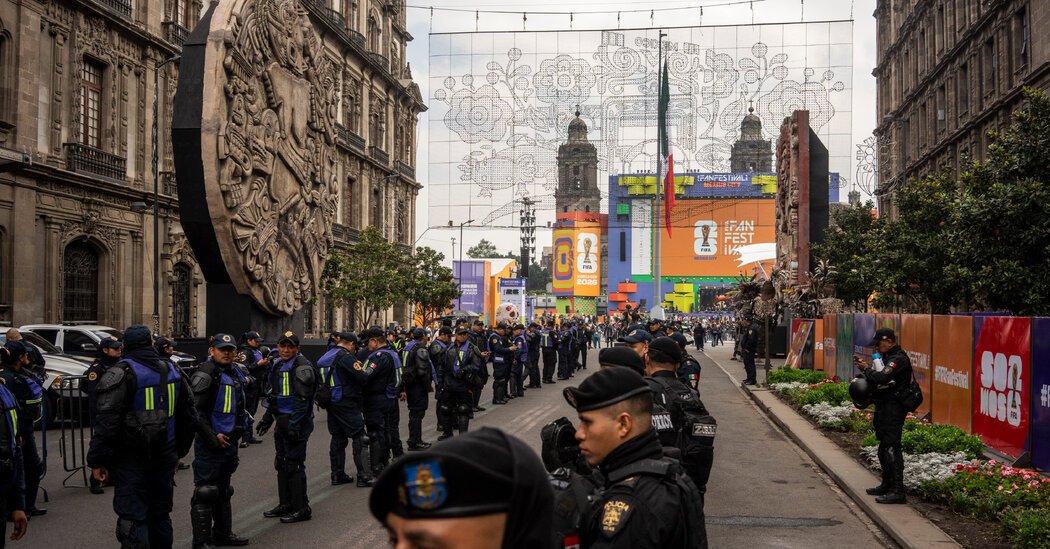
As the largest World Cup ever kicked off in Mexico City on Thursday afternoon, the security around the stadium known colloquially as Estadio Azteca was strict, as large numbers of law enforcement officers held off groups of protesters before the leadoff match between the Mexican national team and South Africa.
This tournament, with a record 48 teams competing, is being jointly hosted by the United States, Canada and Mexico. It will be the first World Cup in which a country, in this case Mexico, has played host three times. It will also be he first time any stadium has held the opening game three times.
Mexico was considered a favorite in this game against South Africa, and it delivered a 2-0 win. The 103 games that follow will be spread across the continent, from Vancouver and Toronto to New York and Kansas City to Monterrey and Guadalajara.
A one-mile radius around the stadium was closed to vehicular traffic, so many people with tickets to the match walked the final portion, and tickets or credentials needed to be shown.
As fans got past security the lines moved relatively quickly for a sporting event of this scale. Fans and workers were told to arrive very early and many took that to heart, with some arriving as early as 6 a.m. for a match that started at 1 p.m. local time.
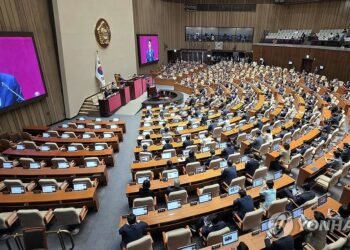
Two hours before kickoff, the stands were fairly full, with an overwhelmingly Mexican crowd already singing traditional songs. The fans let out a giant roar when the members of the national team were shown on the large screens as they got off the team bus outside the stadium. They booed when the South African team appeared on the field before the game.
Nearly the entire sold-out stadium of 81,000 people belted out the Mexican national anthem sung by the popular Mexican singer Alejandro Fernández. Then they tossed colorful paper sombreros that had been left at every seat into the air.
The crowd cheered loudly with every shot and save. But when Julián Quiñones scored not even 10 minutes into the game, the crowd erupted and some threw their beers.
The stadium stayed largely free of protesters, thousands of whom showed up in Mexico City on the first day of the World Cup, even as a small and violent group faced off with police officers outside one gated entrance.
The crowd erupted again, tossed beers and danced when Mexico went up by 2-0. They also cheered boisterously when South Africa drew two red cards. After the final whistle, the fans stood, applauded and sang. Few, if any, protesters were left outside of the stadium, but a large police presence remained.
Aside from the fever for the game, unity has not been the prevailing sentiment among the three host countries, and the execution of this neighboring-allies World Cup has not been seamless.
Since beginning his second term last year, President Trump has repeatedly targeted Mexico and Canada with verbal attacks, vows of military action and tariffs. His administration has enacted a strict immigration policy that has turned away some World Cup participants, journalists and fans.
And just a day before the tournament was set to begin, Mr. Trump took another economic swing at his co-hosts, threatening to let the free trade pact signed by the three countries expire.
“We don’t need anything that Canada has, we don’t need anything that Mexico has, but they need everything that we have,” Mr. Trump said Wednesday in the Oval Office.
Beyond that, there has been widespread criticism of the cost of attending a tournament that was billed as being inclusive. For the first time, FIFA, soccer’s global governing body, has used dynamic pricing, pushing tickets to eye-popping levels, when they can be secured at all.