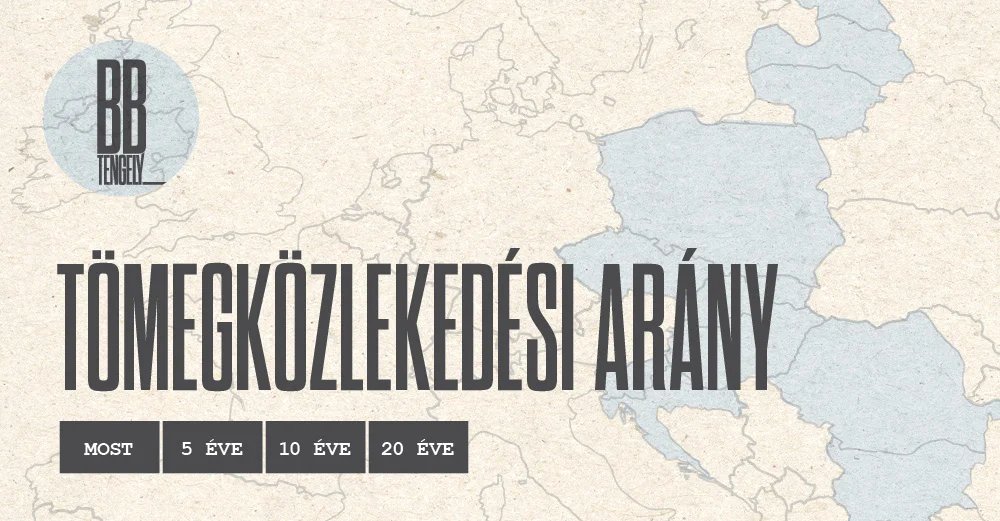
In the last two decades, the population of the BB axis uses the bus and train less and less, the car has become the number one means of mobility. The reorganization can be observed in almost every country, but Hungary has maintained its leading position in terms of the proportion of public transport for twenty years – even though the proportion of people choosing buses and railways has decreased significantly here as well.
Our previous articles a railway and it is highway network have dealt with its physical extent – now the question is more about what people actually use from these infrastructures. Calculated by Eurostat modal split pointer it gives an answer to exactly this: it measures the share of a country’s land passenger traffic – expressed as a percentage – represented by buses and trains together – the remaining share is provided by passenger cars. In the case of a higher value, the economy relies more strongly on public transport, in the case of a lower ratio, the private car dominates mobility.
In the countries of the BB axis, a clear trend emerges over the course of twenty years: the proportion of public transport has decreased, while passenger car mobility has increased.
The regional average was still around 25 percent in 2003, by 2018 it had decreased to close to 19 percent, and today it stands at 16.8 percent. The 2020 coronavirus epidemic temporarily reduced the share of public transport to an even lower level, but the region has since partially restored its previous level.

Hungarians use public transport the most
Hungary is at the top of the current ranking with 24.5 percent. This position remained unchanged for the entire twenty years examined: Hungary ranked first in terms of the public transport ratio in all periods. In addition, compared to its own country, the country experienced a significant decline: in 2003, the value of the indicator was still 38 percent, which meant that nearly two-fifths of passenger traffic was carried out via public transport.
Slovakia, the Czech Republic and Romania follow in the ranking, all three with values between 18 and 22 percent. The Czech Republic is an interesting exception in the regional trend: between 2003 and 2018, the public transport rate remained practically stable at around 24-25 percent, and only after the coronavirus epidemic did it settle to a permanently lower level, at nearly 19.5 percent. Slovakia’s path, on the other hand, is undulating: in 2003, it started from a value above 31 percent, which was the second highest in the region; It decreased to around 22 percent in the first half of the 2010s, and has risen slightly since then.
Bulgaria’s data show the most marked change in the entire field. In 2003, the Bulgarian public transport rate was 33.5 percent – the second highest value in the region. Today, it has decreased to 11.2 percent, which is a drop of 22 percentage points in twenty years – by far the biggest change in the region. In the ranking, Bulgaria moved from the second place to the tenth place, which is a movement of eight places. This huge reorganization is explained by the rapid expansion of the Bulgarian car fleet and the spread of car mobility.


Latvia and Estonia show a similar trend. In Latvia, the public transport rate decreased from 24.3 to 15.8 percent, 8.5 percentage points in twenty years – the country slipped from sixth to eighth place in the ranking. Estonia dropped from 26.4 to 16.4 percent, slipping from fourth to sixth place. In both countries, compared to the beginning of the 2000s, the weight of public transport has decreased significantly.
The rise of cars can be seen in every country
In the case of Lithuania, the indicator remained the lowest throughout. In 2003, the share of public transport was 15 percent, but today it is only 7.9 percent. This means that more than ninety percent of trips are made by car – which means the most car-oriented mobility structure of the entire BB axis. Slovenia and Croatia are also in the lower half of the ranking, although in the case of both countries the change is relatively small over a twenty-year period: Slovenia decreased from 16.5 to 14.5 percent, Croatia from 17.8 to 16.1 percent.
The twenty-year data series shows that the transport structure of the countries of the BB axis has changed in a characteristic way. At the beginning of the 2000s, 25-40 percent of passenger traffic was carried out by public transport, but today this proportion has narrowed to 10 and 25 percent.
The rise of private vehicles has taken place in all countries of the region and bears the imprint of a longer development process: rising incomes, the expanding car fleet and suburbanization have together reshaped the way the region’s residents travel on a daily basis.
THE BB Axis performance of the Baltic and Balkan countries puts it together in a decades-long perspective.
The series you can find the rest here.