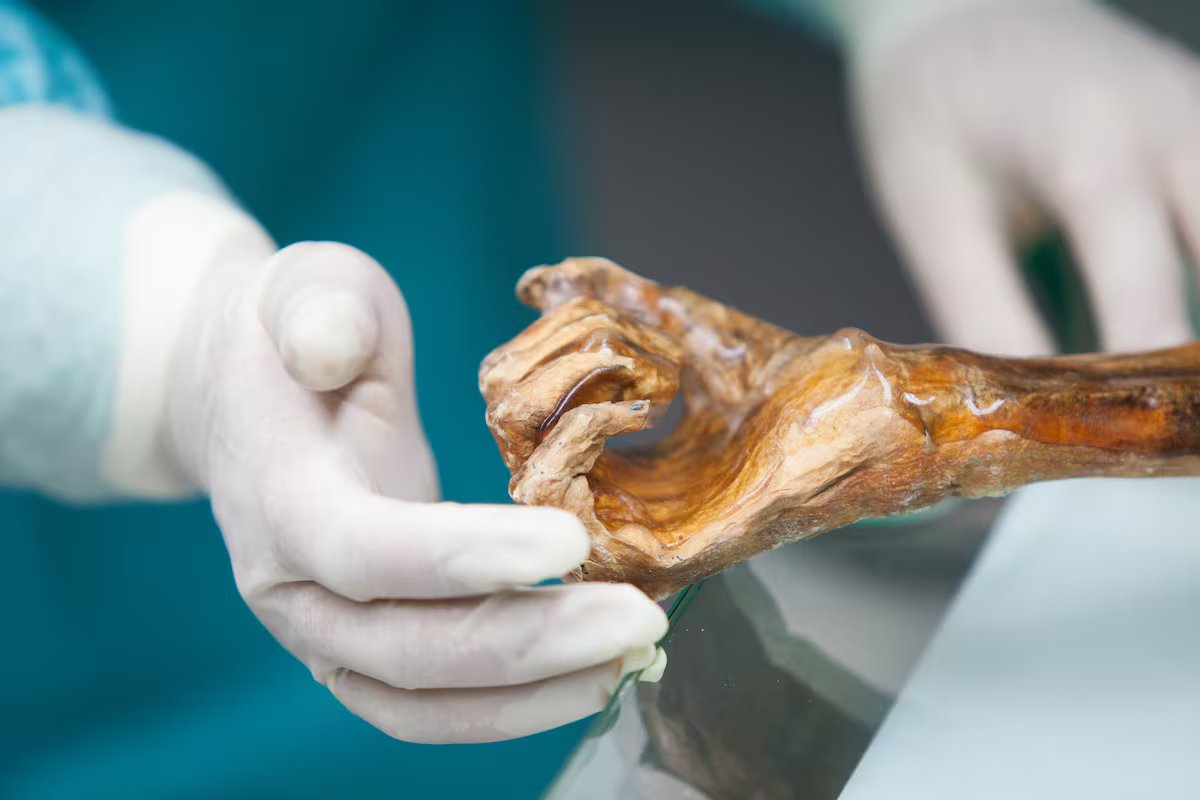
Recovered from the ice of a glacier in the Alps at the end of the last century, almost everything was known about Ötzi. He was about 45 years old when he was killed from behind about 5,300 years ago. An in-depth genetic study revealed three years ago that, in addition to being bald, was dark skinnedand which probably came from distant Anatolia. It is even known what he ate shortly before he was killed of a crush. Now, new research identifies the microscopic life that was inside. The work, published in the specialized magazine Microbiomeshows that their bacteria were very different from those of humans in modern societies. They have also discovered that a series of fungi adapted to the cold have awakened thousands of years later and could compromise the future of the mummy.
“We have identified ancient gut bacteria preserved in Ötzi that are extremely rare in people living modern, industrialized lifestyles, although they can still be found in people with traditional, non-industrialized lifestyles,” says Frank Maixner, director of the Institute for Mummy Studies at the Eurac Research institution (Bolzano, Italy) and senior author of the research. “These microbes give us a unique and valuable image of what the human intestine was like in the Copper Age, before industrialization transformed our microbiota,” Maixner adds in an email.
The researchers took advantage of the rare occasion they had in 2019 when, for five hours, Ötzi was thawed for a series of works on the mummy. At that time, they took samples of his skin and connective tissue, they also used a dozen swabs on as many parts of his body, collected part of the thawed water from his interior, and re-analyzed the soil preserved since 1991 from which they extracted the mummy. They even studied the air in the chamber in which the iceman is kept at always the same temperature (-6º) and 99% humidity, which seeks to replicate the conditions in which he was kept for millennia.
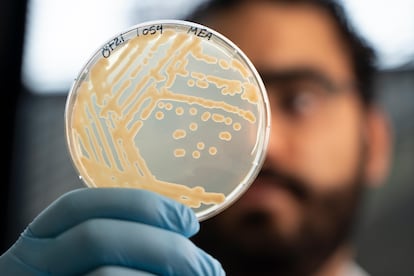
Ötzi’s gut microbiome found now is the same as it was when he died. Typical species of a process have been added to this post mortem. They found a large number and variety of the genus Clostridiaalready detected in some of the Egyptian mummies. Both in the soil and in the thawed water they found microorganisms well adapted to the cold. In particular, they identified four species of fungi, all from the yeast group, such as Glaciozyma watsonii wave Phenoliferia glacialiswhose name already gives clues: these are psychrophilic microbes, accustomed to icy environments. Some of them had already been found very far away, such as the Russian Arctic or Antarctica.
The intriguing thing about these yeasts is that, despite accompanying Ötzi in his death, some of the samples had little damage to their DNA. This would indicate that at least part of those found on the iceman’s skin were active when they were studied. Furthermore, when comparing them with those obtained in 2010, they have confirmed that they have not remained still, that the mummy’s microbial ecosystem did not remain frozen 5,300 years ago. This leads the authors to write in their conclusions: “The crucial question that now arises is whether these yeasts are descendants of ancient yeasts that maintained their multiplication over the years, or whether they were in a dormant state that was reactivated after thawing the mummy.”
According to Maixner, “here we see a continuity. These yeasts have accompanied Ötzi on his long journey through the millennia.” For him, this would demonstrate that the mummy “is not a static relic, but a dynamic biological system.” But also that it may be in danger. When they removed it from the ice, they used a chemical compound (phenol or carbolic acid) to decontaminate it. But, as happens in the fight between antibiotics and bacteria, this stopped the proliferation of some microorganisms, but could have left the door open for the action of others, such as these yeasts that thrive on the iceman’s skin.
“The conservation conditions of the mummy are very stable today,” says Elisabeth Vallazza, director of the South Tyrol Archaeological Museum, which oversees its conservation. “Exhaustive microbiological monitoring ensures that the mummy does not suffer any damage. However, more research and comprehensive conservation efforts are undoubtedly needed to preserve it for many more generations,” he added in a statement.
But the authors of the study are clear that it is no longer enough to keep Ötzi at -6º and a relative air humidity of 99% to freeze the activity of his microbiome. “Our genomic analysis revealed that several of the microbes present—including some cold-adapted yeasts and certain bacteria—carry genes that encode enzymes capable of breaking down proteins, fats and even collagen, a key structural component of the skin and connective tissue,” highlights Maixner, who concludes: “this implies a latent biological risk for the long-term integrity of the mummy.”