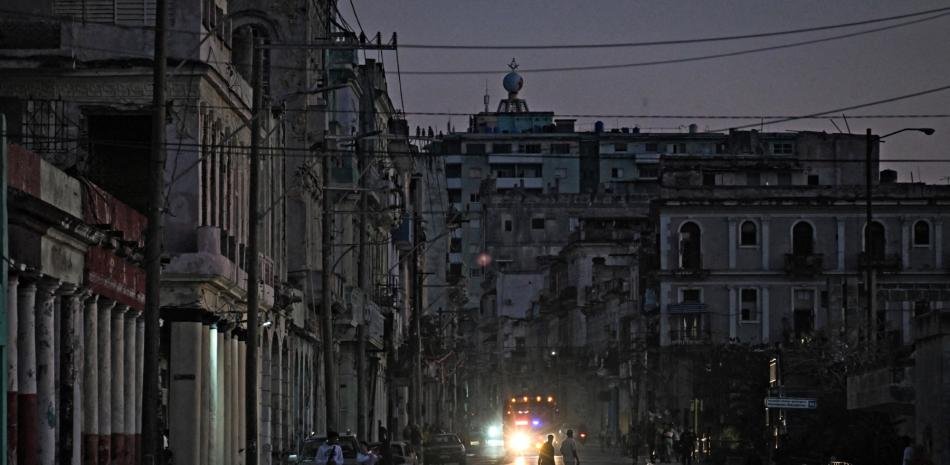
Cuba will suffer this Tuesday prolonged blackouts throughout the day and anticipates that the largest supply outage, at the time of maximum demand, will leave a 60% of the islandaccording to data from the state Electrical Union (UNE), prepared by EFE.
The average Cuban currently suffers more hours without power per day than with electricity.
Since mid-2024, Cuba has been experiencing a serious crisis that deepened with the oil siege imposed by the US Government since January. Washington’s measures have been described by the United Nations as “actions that violate human rights.”
The UNE, attached to the Ministry of Energy and Minesforesees for today’s ‘peak’ hours a generation capacity of 1,180 megawatts (MW) and a maximum demand of 2,850 MW.
Thus, the deficit – the difference between supply and demand – will be 1,670 MW and the estimated impact – what will actually be disconnected to avoid disorderly blackouts – will reach 1,700 MW.
The Caribbean country has suffered in the last 18 months seven disconnections of the National Electroenergy Systemtwo of them registered in the same week last March.
The current energy situation in Cuba is explained by the conjunction of a structural factor, an obsolete energy system with a chronic investment deficit, and a temporary element, the US oil blockade. The Cuban Government has denounced the impact of the sanctions and accuses Washington of “energy asphyxiation.”
On this day, nine of the country’s 16 thermoelectric generation units are not operational due to breakdowns or maintenance work, issues that cannot be attributed to the oil blockade. This energy source is responsible for 40% of the energy mix.
Another 40% of the mix was in charge of the generation engines, but this source of energy, which requires diesel and fuel oil, has been stopped since January due to US pressure, according to the Cuban Government itself. The remaining 20% is obtained from renewable sources and gas, mainly.
Cuba needs some 100,000 barrels of oil daily to cover their energy needs, of which 40,000 They come from their national production.
The Cuban economy has contracted 15% in the last five years and is currently almost completely paralyzed by blackouts, which have also fueled social discontent, visible in the small protests registered in recent weeks.