The chancellor of the New York City Public Schools is under investigation over a no-bid, $180,000 contract for foreign language instructors that was awarded during his previous role in the school system.
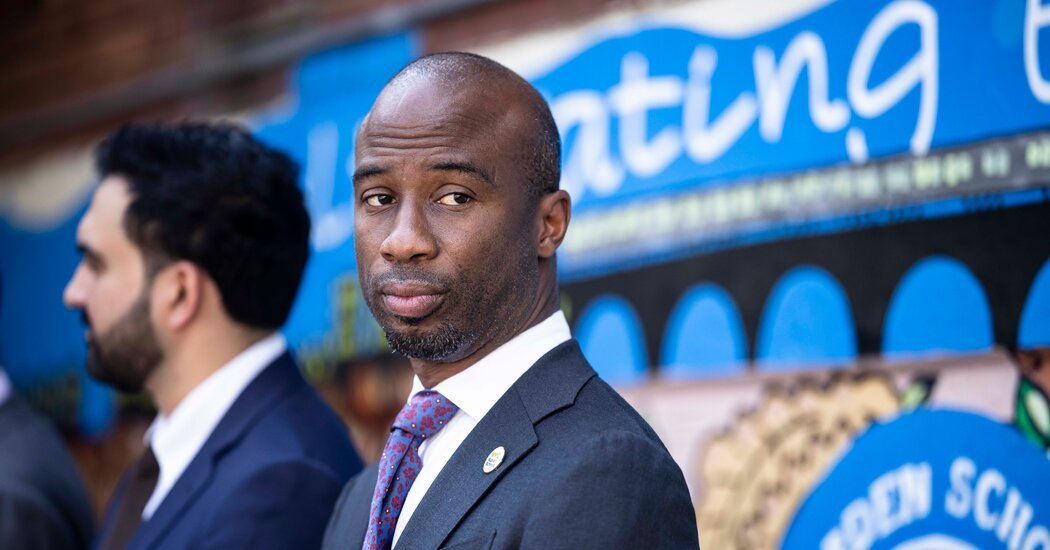
The Special Commissioner of Investigation, an independent watchdog that investigates fraud, corruption and misconduct at the Department of Education, is examining the decision by Kamar Samuels, the chancellor, to split contract payments to a company that provided language instructors starting in the 2023-24 school year.
By doing that, Mr. Samuels avoided the department’s cumbersome procurement rules that would have required him to consider multiple bids. The existence of the review was confirmed by the Office of the Special Commissioner of Investigation.
In a statement on Monday evening, Mr. Samuels acknowledged a “lapse in procedure.” He said that his actions were designed to deliver services to students and “not for personal gain or to benefit anyone other than our schoolchildren.”
Jenna Lyle, a spokeswoman for Mayor Zohran Mamdani, said that City Hall officials are taking the investigation seriously and would review the findings when they are released. “We’ve been pleased with Chancellor Samuels’s leadership of the nation’s largest school district and continue to have confidence in his ability to lead,” Ms. Lyle said.
Mr. Samuels, who was the superintendent of District 3 on the West Side of Manhattan for three and a half years, hired a company in 2023 called Language Learning Network to provide foreign language teachers. Sean Kreyling, the company’s chief executive, said in an interview that Mr. Samuels had signed the contract and had been aware of the billing structure.
The investigation into Mr. Samuels is a sequel to an earlier inquiry by the Special Commissioner of Investigation. That review involved the renewal of the $180,000 contract, which was signed by the then-deputy superintendent of District 3, who reported to Mr. Samuels. That investigation did not look into Mr. Samuels, despite his role in the initial contract.
“They never followed up with me,” Mr. Kreyling said. “It just makes you wonder if they’re really doing an investigation, why didn’t they do so more thoroughly?”
Anna Correa, a spokeswoman for the Special Commissioner of Investigation, defended the agency’s earlier investigation. She said that the new inquiry into Mr. Samuels involves “new allegations,” but declined to provide more details.
The findings from the earlier investigation, which were released in recent weeks, found that the deputy superintendent, Mariela Graham, had arranged a payment structure that broke up payments into smaller amounts that were distributed to two companies tied to Language Learning Network.
Investigators concluded that Ms. Graham “exhibited astoundingly poor judgment.” They wrote that her actions were intended to prevent the contract from facing additional financial scrutiny required of deals that exceed $25,000, which were “put in place specifically to protect the D.O.E. and the public from such financial malfeasance.”
“It is inconceivable that Graham should continue to be employed by the D.O.E. in any capacity,” the report stated, recommending that the Education Department fire her. Ms. Graham, who did not respond to messages seeking comment, is still employed by the school system.
She had told investigators that she knew that Language Learning Network had not been approved as a Department of Education vendor, a requirement for any contract greater than $25,000.
Mr. Samuels, 48, has rapidly ascended the ranks of the New York City school system and was appointed by Mr. Mamdani as the chancellor at the start of his administration.
The investigation into Mr. Samuels appears to have been opened in recent days, according to emails between the Special Commissioner of Investigation and Mr. Kreyling that he shared with The New York Times.
On Friday, Mr. Kreyling said he sent an email to an investigator, offering to share documents and emails involving Mr. Samuels and Ms. Graham that he said previous investigators had not included in their report or had not sought from him. He provided them on Monday.
School districts across the United States have long struggled to hire foreign language teachers. Language Learning Network, based in New Jersey, has a roster of teachers, many of them retired, who can help fill open positions.
The deal in New York City started with an unsolicited email that Mr. Kreyling’s company sent in 2022. His company messaged Mr. Samuels about providing instructors for Arabic, Mandarin, Spanish and other foreign languages.
In New York City schools, principals and school officials have some autonomy to sign contracts and hire vendors without involving the Education Department’s bureaucracy. The larger the contract amount, the greater the financial oversight. Anything larger than $25,000 requires competitive bidding.
But those rules were not followed for the contract for language teachers. Mr. Samuels and Mr. Kreyling, who had never done business with the city’s schools, signed the first contract in 2023, a $180,000 no-bid deal to send teachers to several schools in Manhattan.
The company was expected to continue providing instructors through the 2024-25 school year. Instead, its deal suddenly ended in March 2025.
Mr. Samuels told Mr. Kreyling in an email that the contract had been terminated, according to the message provided by Mr. Kreyling. Two days before, an investigator had emailed Mr. Kreyling and asked if he could discuss a “confidential investigation,” which had been prompted by a whistle-blower complaint about a Language Learning Network instructor who had been barred from working in city schools. That teacher had been investigated more than a decade ago over allegations that he had made inappropriate comments toward students and touched a student’s stomach.
Mr. Kreyling said that he was motivated to urge investigators to examine Mr. Samuels’s role because he believes his company’s reputation had been unfairly tarnished in the earlier inquiry.
Investigators had recommended that the Education Department bar Mr. Kreyling’s companies from receiving future contracts. They faulted his company for providing the instructor who had been barred from the city’s schools.
Mr. Kreyling said a background check had not uncovered concerns with the employee and that he was initially skeptical of the department’s claims because they did not offer proof. He said that he later terminated the employee.
“We feel as though we were induced into a contract that should not have been signed because they were violating their own policies, and now they’re trying to use us as a scapegoat,” Mr. Kreyling said.
Kitty Bennett contributed research.