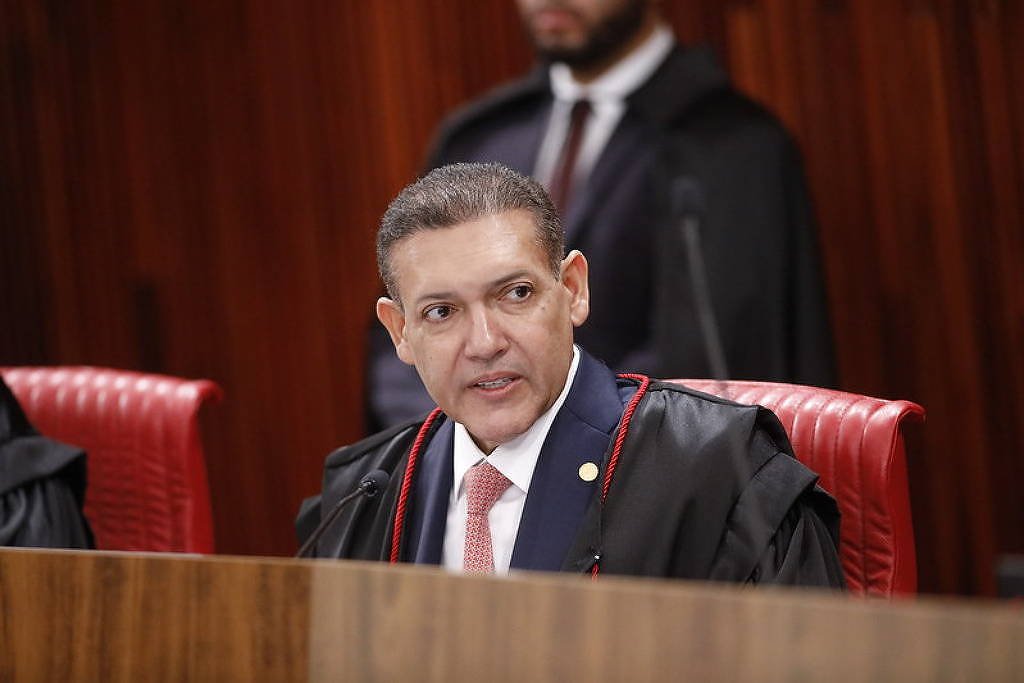
The minister’s decision Kassio Nunes Marquespresident of TSE (Superior Electoral Court), to censure the research from the AtlasIntel institute questioned by the senator’s campaign Flavio Bolsonaro (PL-RJ) is the target of disagreements between lawyers and electoral law experts consulted by Sheet.
THE decision of the president of the TSE was taken in a preliminary (provisional) manner and will still be analyzed by the other ministers in a session of the electoral court on Tuesday night (9). Until further deliberation, AtlasIntel is prohibited from disclosing, promoting or republishing the research.
Among the ears, there are those who point out the distance between the date on which the request was partially granted, this Monday (8), and the publication of the research, on May 19thas an argument against an urgent decision. On the other hand, there are those who understand that even with this interval, possible damage from continued disclosure would justify the measure.
As for the merits of the case, which will still be analyzed in greater detail, after sending technical information by the institute, there is disagreement between those who see an undue limitation to freedom of expression and information and those who believe that there is sufficient evidence of possible contamination of the research for the definitive or, at least, provisional suspension.
Emma Roberta Bueno, electoral lawyer and master in law from IDP (Brazilian Institute of Education, Development and Research), considers that the fact that the research has already been released weeks ago weakens the argument for granting an injunction. For her, it would make more sense for there to be a direct decision by the plenary on the case.
In Emma’s assessment, the political context of high tension regarding the electoral dispute must have weighed on the minister’s decision. As for the merit of the PL’s requests, it does not see arguments that justify suspending the research. “I think we cannot infantilize voters or see them in such need of protection. Voters, in general, are in a good position to assess all of this.”
José Paes Neto, electoral lawyer and vice-president of the OAB-RJ Constitutional Law Commission, sees no problems with the questions that were asked and says that there is no impediment to questioning voters regarding facts that impact the campaign. He sees it as a failure, on the other hand, that the rejection question was asked after the block of questions about Banco Master and understands that this would be enough to contaminate the research.
Neto adds, however, that Minister Kassio Nunes Marques’ decision suggests that questions about voting intentions would also have been asked after these questions and that this may have interfered with the judge’s interpretation of the case.
In his decision, Kassio stated that this is not a methodological disagreement, but a possible induction of the interviewee based on the questionnaire, “especially due to the sequential order of the questions and the use of expressions with a negative evaluative charge”.
“In fact, such circumstances corroborate the arguments deduced initially regarding the possible use of inductive stimuli capable of contaminating subsequent responses regarding image, rejection and voting intention, reinforcing the legal plausibility of the thesis that the research may have gone beyond the limits of regular statistical measurement”, he wrote.
Voters who participated in the online survey were asked 48 questions (voting intention is among the first). The questions about rejection and image perception are arranged after a block of questions about Banco Master and the messages exchanged between Flávio Bolsonaro and Daniel Vorcaro.
Bruno Andrade, member of Abradep (Brazilian Academy of Electoral and Political Law) and professor at IDP, assesses that the decision follows a logic provided for in the legislation and seeks to prevent a possible bias in the questionnaire from somehow misleading voters. According to him, it is now up to the institute to demonstrate that the formulation of the questions had methodological justification and did not manipulate the answers.
The professor states that, although the injunction has a reduced practical impact, as it was granted weeks after the initial release of the research, it may still be important before a plenary decision. This is because the company could, for example, recall the research results and publish them again. Furthermore, there is a symbolic power to leave the institute in check regarding the information it disseminates.
The electoral lawyer and professor of electoral law at FGV Direito SP Fernando Neisser criticizes the decision. According to the expert, there would be a problem if questions about the Master case came before questions about voting intentions, which did not happen. He adds that including topics other than the electoral dispute is a common practice in the research market.
Neisser also says that restricting the circulation of polls requires robust evidence of fraud or serious methodological flaws, because the risk is of limiting freedom of expression and voter access to relevant information. “Attempts to limit (research) have to take place within the limits of the exception of the exception, and not as something commonplace, without a deeper foundation”, he states.
Kassio ordered the AtlasIntel institute to present, within two days, additional technical documentation on the survey methodology, especially in relation to the use of Flávio and Vorcaro’s audio, and asked the Public Electoral Ministry to comment on the case within one day.
João Francisco Meira, president of the Public Opinion and Political Research Council of Abep (Brazilian Association of Research Companies), criticizes the minister’s decision, which he classifies as censorship. He also argues that the understanding of the STF (Supreme Federal Court) contradicts Kassio’s decision.
“Our assessment is extremely negative. It is a decision that does not comply with the fundamental right to information”, says Meira, who is also the founder of the Vox Populi institute.
The AtlasIntel institute is not part of Abep.