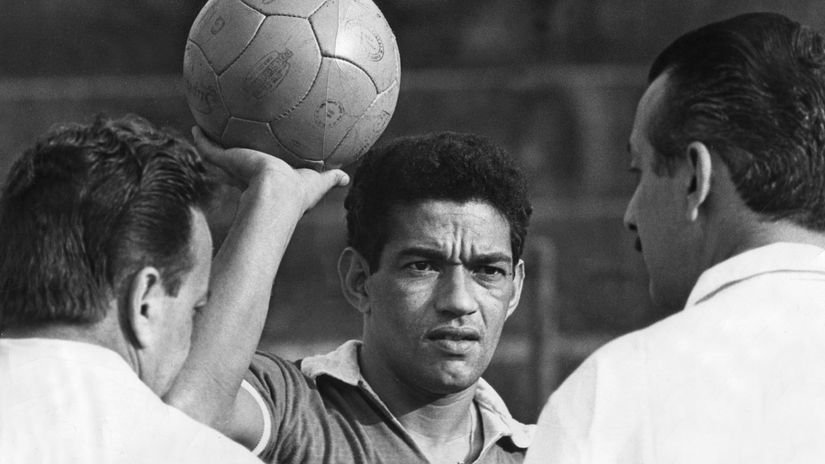
Manuel Francisco dos Santos, better known as Garrincha. The two-time world champion with Brazil (1958 and 1962) was a football genius, a bohemian and a man whose life is as fascinating as it is tragic.
08.06.2026 07:30
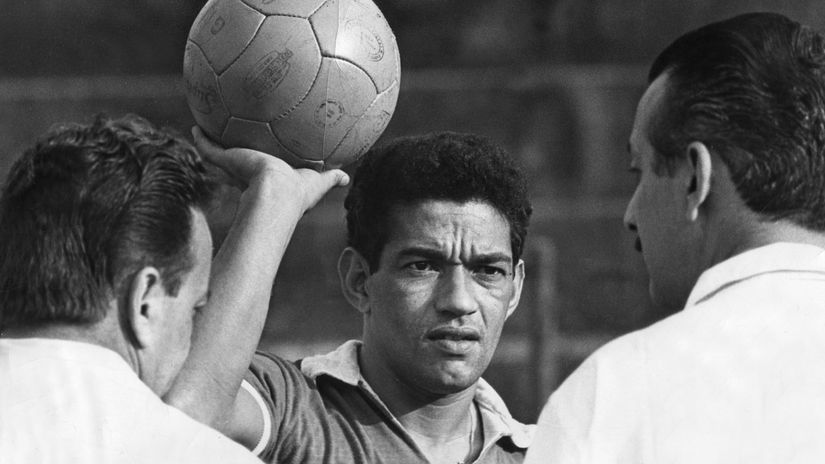
Photo: ČTK / ullstein bild / ullstein bild
Manuel Francisco dos Santos, known by the nickname Garrincha, died at the age of 49 from cirrhosis of the liver.
In Brazil, it is often said in relation to legendary footballers: “Pelé was the king, but Garrincha was the joy of the people.”
While Pelé was a symbol of perfection and professionalism, Garrincha embodied pure emotion, improvisation and the spirit of Brazilian street football. His career is also made incredible by the fact that, according to doctors, he should not have been able to walk normally, let alone play football.
He was born with severe health problems: he had a deformed pelvis and his left leg was up to six centimeters shorter than his right. moreover, it was bent outwards, while the right leg was turned inwards.
Doctors predicted that he would be disabled for life as a child. However, those “crooked legs” became his strongest weapon. Opposing defenders could never predict which way he would go because his body was in an unnatural position.
He spent most of his career at the Brazilian club Botafogo, where he became a legend with more than 230 goals scored and achieved historic success with the Brazilian national team.
In 1958, he won his first world championship title. Interestingly, Garrincha and Pelé started the tournament on the bench because the team psychologist deemed them mentally immature and too childish to cope with a lot of pressure.
Only at the insistence of the older players were they included in the starting line-up – in the third match of the group against the Soviet Union. In the first three minutes of the match, Garrincha performed such dribbling that witnesses called his debut at the World Cup the best three minutes in the history of football.
At the 1962 championship in Chile, Pelé was injured already in the second match against Czechoslovakia (0:0) and all of Brazil fell into despair. Garrincha took over the leadership position – he scored two goals against England (3:1) in the quarter-finals, two against Chile (4:2) in the semi-finals, and after the final triumph over Czechoslovakia 3:1, he led Brazil to the second title in a row.
Garrincha was declared the best football player of the championship and, with four goals, also their top scorer. An interesting fact about two legends: the Brazilian national team has never lost a match in which Pelé and Garrincha ran out onto the field together.
Off the pitch, the phenomenal dribbler was a bohemian and completely ignored lifestyle. He was an avid smoker from the age of twelve, developed a strong addiction to alcohol and had a weakness for women. He was married several times and had countless affairs. He officially recognized fourteen children (although it is believed that there were many more).
The biggest scandal in his life, which directly affected the national team’s preparations for the World Cup, was his relationship with Elsa Soares, one of the biggest stars of Brazilian samba music at the time. When they started dating before the 1962 Chile championship, Garrincha was married to his first wife, Nair, with whom he had eight children.
Elsa Soares was a glamorous fashion icon and extremely popular singer. A passionate and wild romance broke out between them, which immediately became the main topic of Brazilian newspapers. The public was outraged by Soares’ behavior and called her a destroyer of marriages.
Ahead of key training sessions for the World Cup, Garrincha began to be late, skip training and completely stop focusing on football. To justify his absence in front of the strict coach Aymore Moreira and the leadership of the federation, Garrincha kept coming up with bizarre excuses. He often complained of excruciating pain in his knee, claimed that his crooked legs refused to obey him, and that he needed to rest in private at home.
In fact, his knee was fine at the time and he used those days to hide in Soares’ house, away from the public eye and his legal wife. The Football Federation was desperate and panicked at the loss of a key player. The scandal went so far that enraged fans threw stones at the singer’s house in Rio.
Despite all the problems, the love drama in a strange way served as fuel for the football player. Soares traveled to Chile to cheer him on and Garrincha promised to win the World Cup for her. When Pelé was injured, Garrincha played in a trance, motivated by the desire to prove to all of Brazil that his new love had not destroyed his genius football skills.

After 1962, knee injuries, which eventually took their toll from not wearing braces and refusing treatment, and alcoholism destroyed his speed and skill on the turf. At the 1966 World Cup in England, Brazil failed to advance from the group stage after Garrincha suffered his only defeat for the national team against Hungary (1:3).
His relationship with Elsa Soares lasted more than 15 years, but it was destructive. Garrincha, in a drunken state, caused a car accident that killed the singer’s mother, which left deep scars on their relationship. She eventually left him because of his violent behavior under the influence of alcohol.
Garrincha died in 1983 at the age of 49, completely broke, marginalized and devastated by cirrhosis of the liver in a clinic in Rio. Despite this, hundreds of thousands of Brazilians came to his funeral. On his grave in his birthplace of Pau Grande is written: “Here rests in peace the one who was the joy of the people – Mane Garincha.”