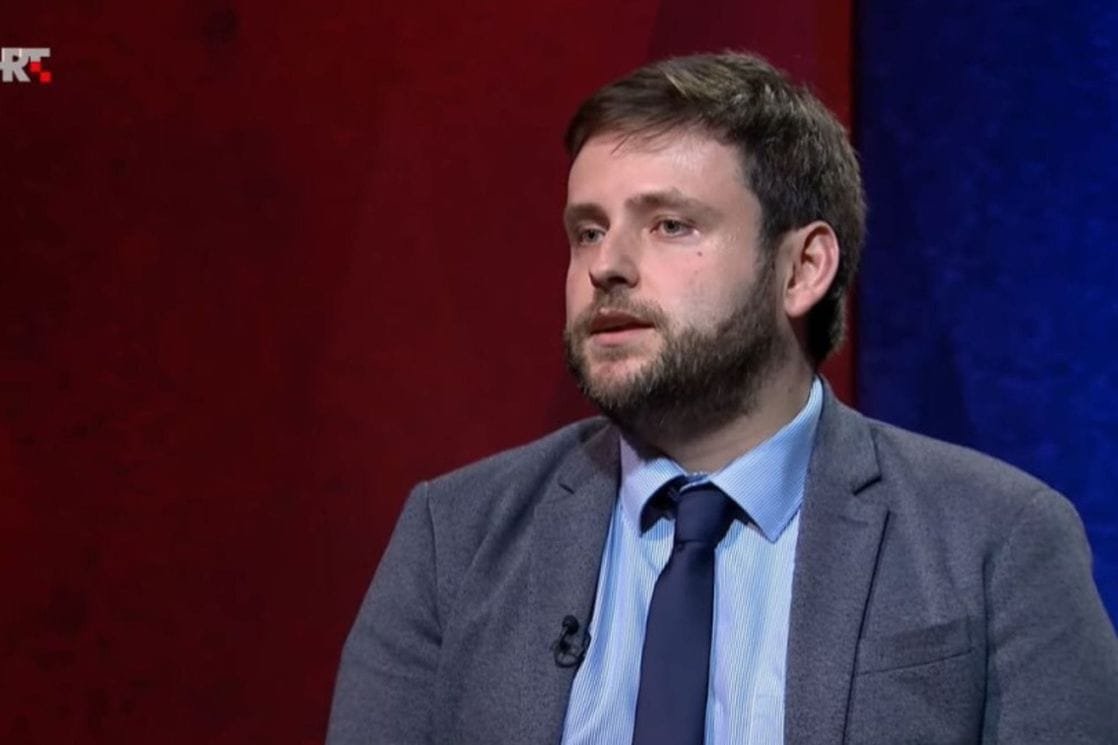
Immediately after closing the negotiation chapters and signing the accession agreement, Montenegro and its citizens could participate in the single European market, as well as in the work of EU institutions – he said in the central news program “24 Sata” on Television E senior analyst for the Western Balkans in the expert organization Initiative for European Stability, Adnan Ćerimagić.
According to him, after the EU-Western Balkans Summit, it was shown that Montenegro can present all diplomatic and technical aspects, while, on the other hand, messages like those from Chancellor Merco are optimistic and aimed at Montenegro adopting reforms as quickly as possible.
He reminds that just a year ago, no one would have believed that so much would be done in Montenegro on the European road, although, as he says, there is still a huge amount of work ahead of the country.
“For part of the remaining work, only the support of the government will not be enough, but a broader consensus will be needed. I believe that if the messages from the European Union are understood so that the EU is serious this time and that Montenegro can really finish the negotiations, every internal obstacle – whether it is ego or unwillingness to share the credit for success – will be overcome,” emphasizes Ćerimagić.
He is of the opinion that then everyone will work in the same direction.
“I am not saying this in the abstract, but based on the experiences of other candidate countries, where in the final stages of the process or in moments of need for a broader consensus, unity was shown when the goal was reached. If, however, in the coming period we listen to skeptical messages from the EU and if the end of the negotiations is again called into question, this will reduce the willingness within Montenegro to sacrifice political points for the sake of the greater good,” said Ćerimagić.
When it comes to Montenegro, Ćerimagić points out that two types of proposals circulating in the public and within European institutions should be distinguished, such as the Merc and Macron non-paper, which does not significantly refer to Montenegro and does not bring many benefits.
“However, in that non-paper, there is a part from which Montenegro could benefit significantly, especially for skeptics who doubt that the EU will eventually confirm the accession agreement and enable full membership. Here we are not only talking about the possibility of participating in the institutions as an observer without the right to vote, which Croatia had after signing the accession agreement, but also the paragraph that foresees full integration into the EU single market, i.e. the application of the four freedoms after the completion of the reforms. In practice, this would mean that, as in the case of Croatia, state representatives would participate in the work of EU institutions after signing agreement, but in the case of Montenegro, it would be extended to citizens and the economy, who could immediately participate in the single market,” Ćerimagić emphasized.
According to him, Chancellor Mertz came to Montenegro with a specific offer concerning Serbia, because for some time behind closed doors there has been talk about the initiative of Berlin and Paris to return Serbia to the European path.
“That initiative implies the opening of negotiations with Serbia, which have been suspended since 2021, through the fulfillment of conditions in the field of justice, electoral legislation, media and foreign and security policy. This would allow Serbia to catch up with countries like Albania, which a few years ago was significantly behind it, and today has made progress in negotiations. Germany and France, in a way, offered President Vučić and Serbia a chance to stop the regression and return to the European path. relations with China and Russia, it is necessary to distinguish between economic cooperation and security and strategic issues. The problem for Europe is precisely the penetration of China into strategic sectors and military-security cooperation, while in relation to Russia, compliance with the EU’s common foreign and security policy is key,” said Ćerimagić.
Montenegro is not where it is by chance
Commenting on the charter flight from Serbia with 90 passengers, 87 of whom were returned from the Tivat airport, Ćerimagić says that it was understood in European capitals as an additional incentive for the EU to try to get Serbia out of the current situation.
“Serbia is in that situation because, from 2022, it interprets the efforts of Montenegro and Albania as futile, claiming that in the end they will be let down, as was the case with North Macedonia. This is precisely why it is important to offer concrete benefits such as access to the single market. This episode once again showed the potential for negative influence in the region, which was previously seen through the incidents in Banjska and the crisis in Bosnia and Herzegovina. The European Union takes this very seriously. When it comes to Montenegro, it has shown institutional maturity and the ability to react, and membership in NATO and progress towards the EU confirm that Montenegro is not where it is by chance,” Ćerimagić concluded.