EL PAÍS offers the América Futura section openly for its daily and global information contribution on sustainable development. If you want to support our journalism, subscribe here.
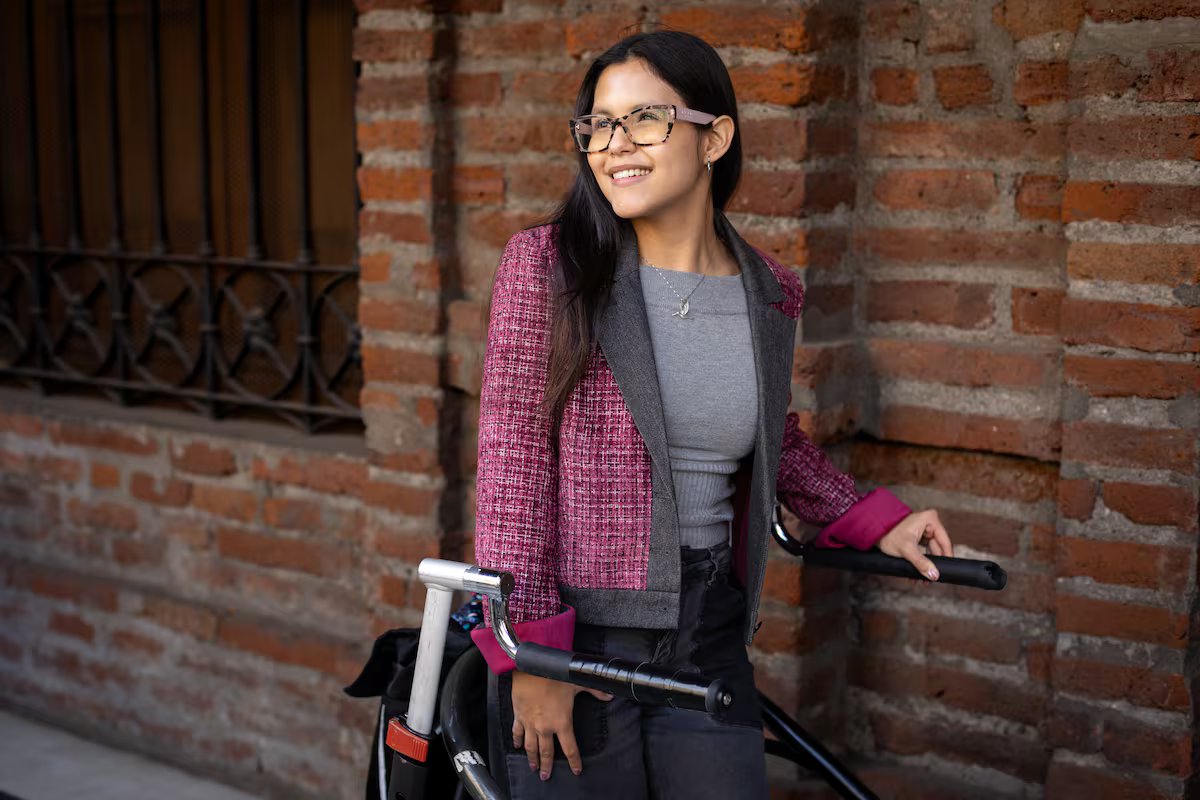
Last month, Isidora Uribe, a 21-year-old Chilean inclusion activist and law student at the Pontifical Catholic University of Chile, traveled to Middelburg, the Netherlands, to receive the Freedom from Want Awarda recognition given by the Roosevelt Foundation to global leaders in justice. Previously, the institution has honored figures such as Angela Merkel, Malala Yousafzai and Nelson Mandela. In Latin America, a few have been recognized, such as the Mexican writer Carlos Fuentesformer president Ernesto Zedillo and the co-founder of United We Dream, Cristina Jiménez Moreta. This year, the jury awarded Uribe for promoting inclusion, equal rights and gender equity, and for empowering young people as mobilizers of change.
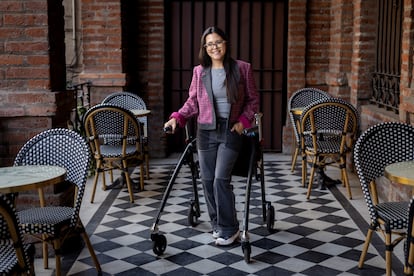
Uribe lives with spastic diplegia, a form of cerebral palsy that affects the mobility of your legsafter a premature birth. He gets around with a walker and sometimes in a wheelchair. Since she was little she attended Teletón, an institution dedicated to child rehabilitation in Chile, and at six years old she was its ambassador. In your instagram shares the path he started from when he wanted to turn exclusion and bullying that he suffered at school. In basic education, his classmates took a wheel off his walker and said phrases like “What do you have legs for if you don’t use them?” and they complained because they had more time to answer tests. “The hardest thing for me was seeing how the system failed me. The school responded: ‘They are children, we have to let them be’. But how can abuse be something natural?” Uribe asks.
Everything changed when, as a teenager, he joined the Institución Teresiana school, where diversity was part of daily life, as it had among its students young people who were autistic, had Down syndrome, and had physical disabilities. “I learned what it means to have support networks and not just in your family. I trusted other people again.” There he created Find your placetoday converted into a national network of young volunteers that organizes courses, discussions and meetings with communities, universities, municipalities and companies. They train others to drive change in their own environments. This outstanding leadership led her in 2022, at age 17, to be named Young Leader for the Sustainable Development Goals by the United Nations and in 2024, at age 19, to speak before Pope Francis on inclusion and disability. Today she participates as a National Youth Gender Activist for UN Women, as a member of the Generation Equality Adolescent Mobilization Committee and the first reference group of the United Nations Youth Office.
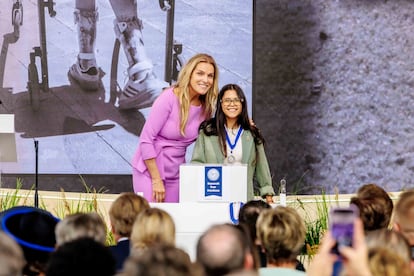
The Chilean still has a hard time sizing up what she experienced in the Netherlands: “I have always seen myself as a young woman with convictions, wanting to raise her voice, to motivate and empower others,” she says. But she never imagined, she adds, that at her age she would be awarded along with figures such as Gisèle Pelicot and the president of Ukraine, Volodymyr Zelensky. Pelicot’s face lit up when Uribe greeted her in French. “He told me that at 21 years old it would never have crossed his mind to do what I have done,” he says. After the ceremony, Zelensky stopped his entourage to congratulate her. “He thanked me for being that much-needed light among so much darkness and hopelessness,” he remembers.
Ask: How is inclusion among young people in Latin America experienced today?
Answer: Intergenerational gaps still persist globally. How many young people frequently hear that they “spend all day on TikTok”, that they “waste their time” or that “they are not going to be anything in life”? That perception weighs. There is no intergenerational respect. Many of us are looked down upon because we don’t have a career. Added to this is the lack of financing for organizations and foundations.
Q: What other barriers exist?
A: Adultcentrism. There is also no concrete accountability on what is done with the participation of young people. There are instances where we are invited to be part of the dialogue, but then many times one, being young, does not know what was done with that information. In English there is the term “tokenism” (the symbolic effort to include people from underrepresented groups to give the appearance of inclusion or diversity). That happens when they make us participate, but only to say that they were with us in a meeting or for a post on social networks. Afterwards, that doesn’t amount to anything concrete.
Q: What do adults need to see about the power that young people have today?
A: That they value our intergenerational perspective. They must not only recognize that we handle technology better, that we use artificial intelligence or that we bring new perspectives, but also understand that what we propose are not just motivational or pretty ideas. We are serious.
Q: You have said that disability depends on the environment. What would you like someone who has never had to think about universal accessibility to understand?
A: I would like you to understand that universal accessibility is freedom and allows us to do basic things. Imagine not being able to go to the bathroom because there is no toilet installed. For a person with a disability, the fact that there is no handrail can be equivalent to that bathroom not existing, because we need that support to move. If the space is too small, it is also no longer usable. In practice, it is as if it were not there. And this is also seen in things that seem simpler. If an elevator is out of service, it may be a hassle for someone without a disability, but they can use the stairs. But for another, means losing the ability to access a place. It is preventing you from arriving, moving forward, achieving your goals and dreams. That is why universal accessibility is so important.
Q: What do you see differently in your generation compared to previous ones when thinking about inclusion?
A: That we do not see it as an act of charity or as a favor, but as a right. A right that all people should have, because it is inclusion that allows everyone to participate, regardless of the environment in which they are. And we all have the right to participate.