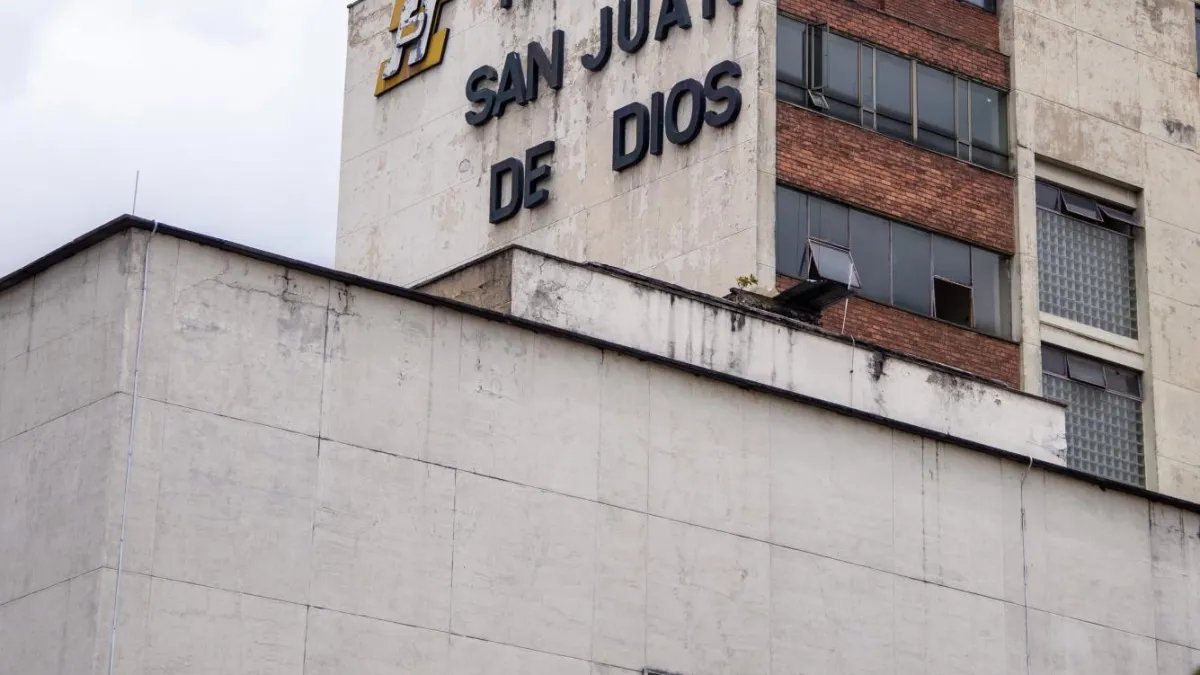
Two in the morning. San Juan de Dios Hospital, Bogotá. Year 1984. In one of the operating rooms, a group of doctors were operating on a patient who was in critical condition due to severe abdominal trauma. The abdomen no longer closed and there was no way to obtain the meshes that, at the time, were used in these cases. In a matter of hours, this problem would end up giving rise to the Bogotá Stock Exchange or Borráez Stock Exchange.
The patient was a young mechanic of about 25 years old who had arrived days before dying. The man was trying to change a tire when the hydraulic jack slipped and the car fell on top of him. The blow caused severe abdominal trauma. The right lobe of the liver, one of the main parts of that organ, was destroyed and a large amount of blood began to accumulate.
READ ALSO
Surgeon Oswaldo Borráez, then a 27-year-old second-year general surgery resident at the National University, performed emergency surgery on him after resuscitation. They removed the destroyed liver tissue, controlled the bleeding, checked for additional injuries, and closed the abdomen. However, this would only be the first of four surgeries performed on the young man.
Two days later, the patient returned to the operating room. He had become destabilized and they suspected new bleeding. They found around 500 cubic centimeters of blood inside the abdomen. They cleaned again, checked the liver area and closed again.
72 hours later there was a third surgery. The patient needed more oxygen to remain stable, his heart began to beat faster than normal and his blood pressure began to drop, signs that made doctors think that something was not right inside the abdomen and that it was probably an infection.
When they reopened it, they found an abscess, a collection of pus caused by an infection, near the area of the liver that had been injured. Part of the affected tissue had lost vitality, that is, it had begun to die (necrotize) and ended up becoming infected. The doctors drained the infection, washed the abdomen again, and closed it again.
San Juan de Dios Hospital. Identification of Dr. Oswaldo Borráez. Photo:Courtesy
The decision to risk everything
Three days later he returned to the operating room for the fourth time. The large amount of fluids used to keep him alive had caused severe inflammation. Not only was the skin swollen, the intestines had also increased in size and occupied a volume that made it impossible to close the abdominal wall.
Although he was not on duty that night, Borráez was at the hospital and attended to the emergency when he saw that it was his patient. “The night before I was not on duty, but obviously I had to take care of my patient and re-operate on him. We could spend a week without leaving the hospital. That was the training there in San Juan de Dios,” he recalled.
They couldn’t close it. The alternative at the time was synthetic tights. Dr. Borráez requested the bags. There wasn’t. At that hour of the morning there was no way to get them either.
READ ALSO
“So, we said: ‘Wednesday, what am I going to close this patient with?’ Looking at the serums, I asked them to give me a plastic bag of serum, the big three-liter ones,” said the surgeon.
The liquid was collected and used to finish washing the patient’s abdominal cavity. Then he took the bag, opened it and cut it. Borráez fixed around the abdomen, in 360 degrees, temporarily replacing the abdominal wall that could no longer close.
“It was a controversy because the risk that we ran and especially me who had made the decision to be sanctioned and even voted out of the surgery program of the National University in the hospital was high or at least I was going to have a tremendous scolding,” Borráez recalled.
Oswaldo Borráez, doctor of medicine and surgery, specialist in general surgery at Unal. Photo:Tatiana Moreno. The Time.
Close to finishing the surgery, with very little left to fix the bag, Borráez and his team decided to call a surgery instructor. The doctor went down to the operating room where the Bogotá Stock Exchange had been created.
– No! Take that bag off, how do you happen to put that in? Who told you that? “Where did you read that?” said the instructor.
—Roberto, there is nothing to close the patient with. “Please don’t go to the room, at least so that I feel that there was your support and tomorrow I won’t have so many difficulties,” the surgeon responded.
They finished the surgery and the patient returned to the intensive care unit with the IV bag fixed to his abdomen and covered with compresses while the doctors continued to monitor his progress.
READ ALSO
Eight in the morning. Office of the chief of surgery. Oswaldo Borráez received the call from the professor, head of the surgery service. Whom he remembers as a very respectful person, he didn’t even greet him that day.
—What happened last night? How is it possible that you, a surgeon from San Juan de Dios, a surgeon from the National University of Colombia, have not been able to close a patient?—said the head of surgery.
Borráez summarized the case and proposed reviewing the patient before making any decision. They went down to the intensive care unit. The professor silently observed the abdomen covered by that improvised transparent bag. He walked around the bed and left without saying much.
The young doctor, 27 years old, came out behind the professor and asked him what he should do with the patient.
“Don’t do anything because you’re going to die anyway,” he said.
He was an “extremely critical” patient, with four surgeries and multiple risks. Against the initial forecast, it began to evolve. The doctors removed the bag, carried out the necessary washings and replaced another one.
As the days passed, the team decided to modify the technique; They stopped attaching it to the aponeurosis, the layer of tissue that covers and supports the muscles of the abdomen, and began attaching it directly to the skin.
The second case
Two weeks later, Borráez was on duty when he was called to the operating room. Since he was the highest-ranking resident of the group, he went up to review the case. A gynecology team was operating on a patient referred from the Materno Infantil intensive care unit: a woman with a severe abdominal infection who had already had her uterus removed and whose abdomen could not close due to inflammation of the intestines.
“I went in and greeted the professor and told him what was offered. He told me that she was a very obese lady, with a severe intra-abdominal infection (…) and that they could not close it due to the great inflammation of the intestines. I told him what I had done two weeks ago with that patient that I had in the unit,” Borráez recalled.
“He looked at me skeptically and finally told me: ‘Well, doctor, go in and do what you think, because I don’t have that experience,’” said the surgeon. So he and his fellow gynecology residents performed the procedure.
“In two weeks I didn’t have one problem, but two, because the professors were on top of our group regarding the evolution of these patients. Fortunately, both patients were improving every day, we were washing them less and less,” said the surgeon.
Both patients left the intensive care unit and were admitted to hospital. They remained hospitalized for several months until, over time, the same organism ended up expelling the plastic bag: new skin began to form under it.
The technique began to be repeated with increasing frequency at the San Juan de Dios Hospital. “When we had severely infected patients, we put a bag on them because we knew we had to reoperate on them or severely traumatized patients that we couldn’t close,” Borráez recalled. In less than a year, in their surgery group alone they had already accumulated nearly 260 cases treated with this technique.
Approximately a year later, when Borráez was finishing his training, Michael L. Feliciano, an American surgeon, known internationally for his contributions in trauma surgery and critical patient care, visited the San Juan de Dios Hospital. There he found dozens of patients with those plastic bags fixed to their abdomens and asked what they were about.
The medical team explained why they used this technique and in which cases it worked. It was he who ended up baptizing it as the ‘Bogotá Stock Exchange’, the name by which it began to become known internationally.
Years later, during a conference in the United States, Feliciano himself proposed another idea. As Borráez remembers, he said that the technique should bear the name of the person who had created it and proposed calling it ‘Borraez Bag’. Since then, both names—Bolsa de Bogotá or Bolsa de Borráez—have been used interchangeably in different parts of the world.
More than four decades after that early morning in 1984, the technique continues to be used in different countries. As Borráez recalls, its usefulness remains in severely infected or traumatized patients who cannot be closed conventionally and who will probably have to return to surgery.
TATIANA MORENO QUINTERO
BOGOTÁ EDITORIAL