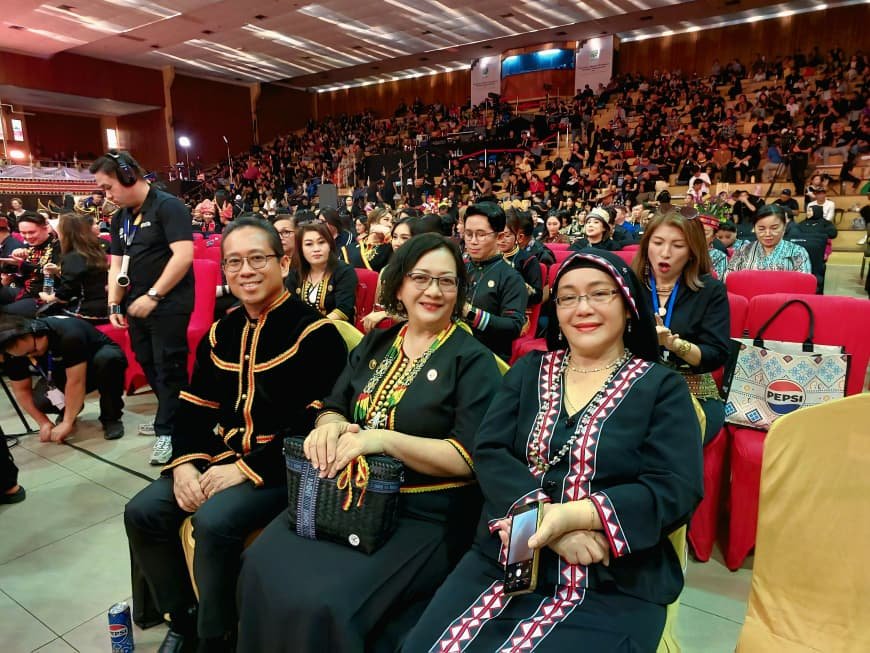

The columnist joined thousands of revellers at Hongkod Koisaan, Penampang, on 31 May 2026 to celebrate the grand culmination of the Kaamatan Festival
 EVERY year in May, Sabah comes alive with the sounds of gongs, the graceful movements of the Sumazau dance, the colourful display of traditional attire and the communal spirit of Kaamatan celebrations. For many Sabahans, Kaamatan is more than a cultural festival. It is a symbol of heritage, identity, unity and historical continuity. Yet beneath the celebrations lies a deeper and increasingly important question: what does Kaamatan truly mean for Momogun or indigenous identity in modern Sabah?
In today’s rapidly changing world, the Kadazandusun and other Momogun communities face growing pressures from urbanisation, globalisation, technological change, cultural assimilation and shifting social values. Kaamatan remains one of the few major cultural platforms where Momogun identity is publicly celebrated and visibly affirmed. However, while the festival has grown in popularity and visibility, there are growing concerns about whether its deeper meaning and cultural essence are gradually being overshadowed by commercialisation, entertainment culture and superficial representation.
Historically, Kaamatan originated as a harvest thanksgiving celebration among the Momogun agricultural communities of Sabah, particularly the Kadazandusun people. The festival was deeply rooted in spirituality, communal cooperation and the intimate relationship between humanity and nature. Traditional rituals honoured Bambazon or Bambarayon, the rice spirit, reflecting the belief that rice symbolised life itself.
In earlier generations, Kaamatan represented far more than an annual event; it formed an integral part of the broader Momogun worldview and way of life. Language, customs, farming practices, oral traditions, folklore and communal values formed the foundation of Momogun identity. Villages functioned as close-knit communities where traditions were passed down naturally from elders to younger generations.
Modern Sabah, however, is vastly different from the rural and agricultural society of the past. Urbanisation has transformed lifestyles and aspirations. Many young Sabahans now grow up in urban areas with limited exposure to traditional village life. English and Malay increasingly dominate communication while Momogun languages face gradual decline in many households. Social media, digital entertainment and global popular culture exert powerful influence over younger generations.
As a result, Kaamatan has become increasingly important as a symbol of Momogun cultural survival. For many Kadazandusun and Momogun communities, the festival represents one of the few remaining spaces where Momogun identity receives widespread public recognition and celebration.
Yet this growing visibility raises important concerns. While Kaamatan celebrations today are larger, more colourful and more commercially successful than before, some critics argue that the festival risks becoming overly focused on entertainment and spectacle rather than cultural substance.
In many urban celebrations, traditional elements are sometimes reduced to performances for audiences rather than expressions of lived cultural identity. Traditional dances may be performed beautifully on stage, yet many young participants often lack a full understanding of the historical and cultural meanings behind them. Traditional attire is proudly worn during Kaamatan season but outside the festival period, Momogun languages and customs often receive far less attention in daily life.
This contradiction raises uncomfortable but necessary questions. Is Kaamatan preserving Momogun identity or is it merely showcasing fragments of culture within a modern entertainment framework? Are younger generations truly understanding their heritage or are they simply participating in annual festivities without deeper cultural connection?
One of the clearer signs of concern involves language preservation. Momogun languages form an essential part of cultural identity because they carry traditional knowledge, worldview, oral history and communal memory. Yet many urban Momogun families today no longer speak Kadazandusun or other Momogun languages regularly at home.
Some young Sabahans understand only basic conversational phrases while others are unable to speak their ancestral languages at all. Although Kaamatan often features speeches, songs and cultural presentations in Momogun languages, such usage sometimes becomes symbolic rather than practical. A language requires regular use in daily life if it is to remain alive and vibrant.
This gradual erosion of language reflects broader cultural shifts taking place within modern Sabah. Economic realities, educational demands, migration and urban lifestyles have encouraged many families to prioritise dominant languages perceived as more economically useful. While such choices are understandable, they inevitably affect cultural continuity.
Kaamatan therefore plays an increasingly important role in reminding Momogun communities about the importance of preserving language and cultural knowledge. However, reminders alone are unlikely to suffice. More systematic efforts involving schools, families, community organisations and cultural institutions are necessary if Momogun languages are to remain vibrant for future generations.
The Unduk Ngadau Kaamatan pageant likewise reflects both the strengths and challenges surrounding Momogun identity in modern Sabah. Originally rooted in the legend of Huminodun, the sacrificial daughter whose spirit gave life to rice and ensured the survival of the people, the pageant carries profound cultural and spiritual symbolism.
Today, the Unduk Ngadau Kaamatan pageant continues to attract widespread attention and admiration. Many contestants are intelligent, articulate, culturally knowledgeable and highly accomplished young women who serve as positive role models for society. The pageant has evolved beyond physical beauty into a platform promoting leadership, confidence, cultural representation and public speaking skills.
At the same time, some observers question whether modern pageantry risks commercialising or simplifying Momogun womanhood into idealised images shaped partly by social media and contemporary beauty standards. There are concerns that glamour, fashion and popularity may sometimes overshadow deeper cultural understanding and historical significance.
This criticism leaves the value of the Unduk Ngadau Kaamatan tradition itself intact. Rather, it highlights the need to preserve the cultural depth and historical meaning behind the pageant rather than allowing it to become overly influenced by modern commercial expectations.
Kaamatan’s growing popularity among non-Momogun communities presents another interesting dimension of identity in Sabah. Today, Kaamatan is celebrated not only by Kadazandusun and Momogun communities but by Sabahans of all ethnic and religious backgrounds. Malays, Chinese, Indians and other local groups participate actively in festivities across the state.
This inclusivity reflects Sabah’s long-standing culture of social harmony and mutual respect. In many ways, Kaamatan has successfully evolved into a broader symbol of Sabahan identity rather than remaining confined to a single ethnic community. Such inclusivity strengthens unity and intercultural understanding.
However, there is a delicate balance to maintain. As Kaamatan becomes increasingly mainstream and commercialised, there is a risk that Momogun voices and perspectives could gradually become diluted within larger public narratives. Cultural festivals that become highly commercialised sometimes lose connection with the communities that originally created them.
For Momogun communities, preserving authenticity while embracing inclusivity remains an ongoing challenge. Kaamatan needs to continue evolving with modern society while retaining the cultural foundations and Momogun perspectives that give it meaning.
Another important issue concerns the way Momogun identity is represented economically and politically in modern Sabah. Kaamatan celebrations often showcase Momogun culture proudly on stage, yet many rural Momogun communities continue facing socio-economic challenges, including poverty, limited infrastructure, educational inequality and restricted economic opportunities.
Some critics argue that celebrating Momogun culture symbolically during Kaamatan means little if deeper structural issues affecting Momogun communities remain insufficiently addressed. Cultural pride alone remains insufficient to address socio-economic disparities. Momogun identity must be accompanied by genuine empowerment, educational advancement, economic participation and equitable development opportunities.
This critical perspective leaves the importance of Kaamatan unchanged. Instead, it challenges society to ensure that cultural celebration is accompanied by meaningful progress for Momogun communities themselves.
Young Sabahans today are navigating increasingly complex identities. Many move between traditional village roots and modern urban lifestyles. They consume global popular culture while attempting to preserve local heritage. They use digital technology and social media while seeking connection to ancestral traditions.
In this environment, Kaamatan can serve either as a superficial annual celebration or as a meaningful platform for cultural education and identity formation. The outcome depends greatly on the way society approaches the festival.
Educational institutions play a vital role. Schools and universities can integrate Momogun history, language, literature, folklore and cultural studies more actively into educational programmes. Cultural learning should extend beyond performances and costumes to include deeper understanding of Momogun philosophy, worldview and historical experience.
Social media likewise present both opportunities and challenges. On one hand, digital platforms can promote cultural awareness, Momogun languages, traditional music, handicrafts and historical knowledge to wider audiences. Young Sabahans increasingly create online content celebrating indigenous identity and heritage.
On the other hand, social media can sometimes encourage superficial representation where culture becomes reduced to aesthetic imagery rather than meaningful understanding. Cultural identity risks becoming performative if external appearances receive greater attention than deeper values and knowledge.
Despite these concerns, Kaamatan remains a powerful symbol of resilience and continuity for Momogun communities in Sabah. The fact that the festival continues to thrive in a rapidly modernising society demonstrates the enduring strength of Momogun culture and identity.
Many young Sabahans still take pride in learning traditional dances, wearing ethnic attire, participating in cultural events and reconnecting with their ancestral heritage. Rural communities continue preserving traditional knowledge, customs, music and crafts that form important parts of Sabah’s cultural landscape.
Crucially, Momogun identity in modern Sabah is best understood as dynamic and evolving rather than static or frozen in the past. Cultures naturally evolve over time. Preserving identity involves embracing cultural roots alongside modernity and progress. It means ensuring that cultural roots remain meaningful and relevant within changing social realities.
Kaamatan therefore represents both celebration and reflection. It celebrates the survival and visibility of Momogun identity while simultaneously reminding Sabahans about the ongoing responsibilities of cultural preservation.
The future of Momogun identity in Sabah will depend not only on annual festivals but on everyday commitment, within families, schools, communities, institutions and public policy. Languages must continue to be spoken. Traditional knowledge must continue to be taught. Cultural heritage must continue to be valued beyond ceremonial occasions.
Ultimately, Kaamatan is far more than music, pageantry and festivities. It is a mirror reflecting the state of Momogun identity in modern Sabah, revealing both the enduring strength of cultural resilience and the challenges of cultural survival in an increasingly globalised world. Its true significance lies not merely in celebrating tradition during the month of May but in ensuring that Momogun identity continues to live, thrive and command respect for generations to come.
Dr Richard A. Gontusan is a Human Resource Skills Training and Investment Consultant. He writes on academic, economic, political and social issues. His views expressed in this article are not necessarily the views of The Borneo Post.