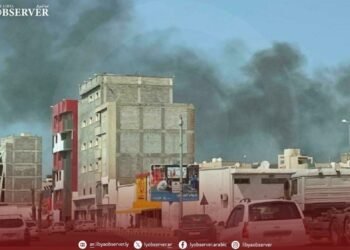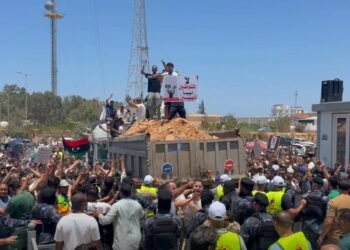
Libya’s Tripoli based Internal Security Agency claimed that it has uncovered an organised plot to destabilize public security and target state institutions. This is a reference to the violent demonstration by football fans that burnt parts of the Prime Minister’s Office on 14 May.
The Internal Security Agency said that following up on the events that ensued after a recent public demonstration, and based on the findings of the Internal Security Service’s monitoring, investigation, and inquiry operations, documented with verifiable physical, technical, and digital evidence, specialized teams have identified 221 individuals involved in the riots and acts of vandalism that occurred in the capital.
The Agency claimed that the results of its investigations indicate that they were not merely spontaneous protests or riots, but rather the work of organised elements who were prepared in advance to exploit the public discontent and direct it toward acts of violence targeting state institutions, most notably the Prime Minister’s office, as well as military and security personnel and checkpoints.
It claimed that the Agency’s specialized technical teams were able to collect and analyse a large amount of digital and technical evidence that definitively revealed calls for mobilization and disruption of public order, as well as the use of violence against military and security forces and government buildings. This evidence, it added, also proved participation in and incitement to acts of sabotage. Weapons, equipment, and prohibited fireworks were also seized in the vicinity of the Prime Minister’s office and along several roads and routes leading to it.
Furthermore, it claimed that the investigations successfully dismantled the methods and tactics employed by the individuals involved in the attacks. These included attempts to disable surveillance systems, attacks on security equipment, and efforts to seize weapons. This confirms that the incidents transcended random acts of sabotage and constituted organized actions with specific objectives. This, the Security Service claimed was corroborated by the confessions of several detainees involved in these acts.
The Agency claimed that the investigations also revealed communication and coordination channels used in mobilizing, directing, and planning the acts of sabotage. These channels included the distribution of roles and tasks among a number of participants, as well as attempts to recruit additional members and pay them to participate in field operations. This confirms the organised nature of the actions targeting public security and state institutions.
The Internal Security Agency claimed that the findings underscore the high competence of its personnel and their ability to monitor, track, analyse, and uncover organised plots. This enabled them to thwart attempts to plunge the capital into chaos and attack state institutions, preventing the achievement of these objectives and reinforcing security, stability, and the rule of law.
The Internal Security Service announced that it will soon broadcast a comprehensive video recording containing the digital, technical, and physical evidence gathered during the investigations, along with documented confessions from a number of those involved. This, it claimed, will reveal the true nature and details of the plot to the public and confirm the legality of the procedures taken by the competent authorities.
The Internal Security Service affirmed that the findings of the investigations reinforce the existence of a systematic pattern aimed at exploiting public events and occasions to incite chaos and disrupt security and stability, which necessitates a firm response in accordance with the law.
The Agency claimed that the outcome of this case exemplifies the effectiveness of state institutions and their ability to protect citizens’ security and counter plots aimed at destabilising the country. It added that this further affirms that security agencies will continue to perform their duties with unwavering resolve and competence and will not allow any entity or group to compromise national security or target its institutions.
The Agency reiterated its call for citizens to cooperate with the relevant authorities to maintain security and stability and preserve social peace, stressing that the state has been and will remain present and capable of protecting its institutions and citizens and enforcing the law on everyone without exception.
The riot that was sparked by the suspension of a football match
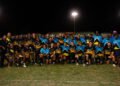
It will be recalled that demonstrating fans from Tripoli’s Al-Ittihad Football Club set fire to part of Prime Minister Abdel Hamid Aldabaiba’s Tripoli Cabinet Office on Sikka Road on the evening of 14 May.
The demonstrating Al-Ittihad fans were protesting against the calling-off of their club’s football match earlier in the evening against the Misrata-based Al-Suwaihli football club. PM Aldabaiba is from Misrata.
The referee had decided to suspend the match, being held in the neutral location of Tarhuna (90 km and about 120 minutes’ drive south of Tripoli), three minutes before the end of regulation time after several perceived refereeing decisions in favour of the Misrata-based club. The match was part of the third round of the Libyan Premier League championship playoffs.
Reacting to the suspension of the match, some fans stormed the field, causing some damage and burning an outside broadcasting vehicle. The army forces at the match, the 444 Brigade counter-reacted to the hooliganism and rioting by the fans by, reportedly, opening fire using live ammunition. The situation spiralled. A soldier was killed – probably by friendly fire.
The news of the suspension of the match in Tarhuna and the reported firing of live ammunition spread to the Tripoli based Al-Ittihad football clubs Tripoli fans, who reacted by demonstrating at the PM’s Cabinet Office. It is reported that at the Cabinet Office, security forces again fired live ammunition to disperse the demonstrating fans. Fire was set to parts of the Cabinet Office, which was eventually put out.
.