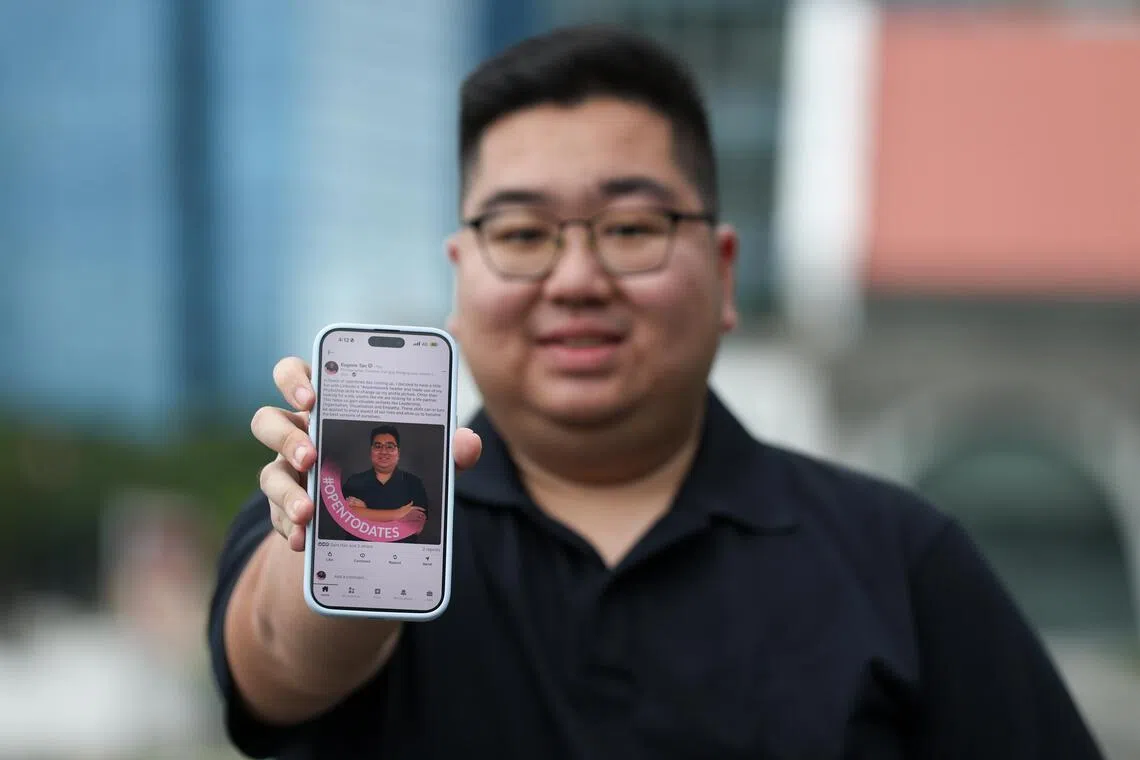
SINGAPORE – On freelance photographer and videographer Eugene Tan’s LinkedIn profile picture sits a familiar ring styled after the professional networking platform’s “Open To Work” badge.
Except, instead of the usual green hashtag banner signalling availability to recruiters, the 23-year-old has a bright pink #OpenToDates badge edited on Photoshop.
The parody does not stop there.
In a Valentine’s Day LinkedIn post in the style of the millions of hyper-reflective career essays that flood the platform, Mr Tan writes that beyond a job, “youths like me are looking for a life partner too”, adding that relationships teach valuable skills such as leadership, organisation, visualisation and empathy – an acrostic whose first letters spell the word “love”.
It is, by his own admission, “50 per cent unserious, 50 per cent serious”.
“If something happens, then it happens,” he tells The Straits Times. “But if nothing happens, I’m okay with it.”

Mr Eugene Tan resorted to looking for love on LinkedIn after growing tired of dating apps, where interactions felt repetitive and overly curated.
PHOTO: EUGENE TAN/LINKEDIN
No dates emerged from the experiment. No romantic confessions slid into his inbox. Instead, secondary school classmates, polytechnic friends and old acquaintances resurfaced to tell him the post was funny.
One unexpected message from Singapore-based matchmaking agency Lunch Actually appeared in his LinkedIn inbox shortly after – proof, perhaps, that the algorithm nailed the assignment faster than any woman.
Across the platform, especially in India and the United States, users have begun posting dating resumes, compatibility decks, self-introductions and profile banners tagged with labels like #OpenToDate and #OpenToDM.
Screenshots of men posting elaborate dating “applications” and resume-style romantic pitches on LinkedIn have also spread across TikTok, Instagram and X. In the comments, reactions range from mockery and disbelief to admiration over the confidence and creativity behind these posts.
A TikTok search for “dating on LinkedIn” throws up dozens of videos documenting relationships that began on the platform – particularly in the US.
Among them is US-based lifestyle influencer Paige Goldstein with 21,300 followers. She posted in 2025 that she met her boyfriend on the platform after she began sharing more personal content on it. That expanded her network, a mutual connection tagged her in one of his posts and the rest is history.
Such lovelorn humour, personality and casual self-presentation – once largely relegated to social media platforms like Instagram and TikTok – have found their way onto LinkedIn.
Assistant Professor Lew Zijian of Nanyang Technological University’s Wee Kim Wee School of Communication and Information, who researches online self-presentation and digital behaviour, does not find this surprising.
Using LinkedIn to look for romance is simply an extension of how people already use Instagram, TikTok and Facebook to meet potential partners, except LinkedIn allows users to see far more of a person before speaking to him or her.
“With dating apps, there’s an element of chance or some sort of unknown algorithm working for or against you,” says Prof Lew. On LinkedIn, by contrast, “people know exactly who they are approaching”.
The profile is already there – so are the schools, jobs, public posts and years of accumulated self-presentation. Users get an instant rough sketch of a person’s ambitions and worldview. Or, as Prof Lew puts it more bluntly, LinkedIn gives users “a better sense of whether you’d be dating a clown or not”.

Freelance photographer-videographer Eugene Tan pitched himself as a prospective romantic partner on LinkedIn.
ST PHOTO: SARAH LEE
That was the reason Mr Tan resorted to looking for love on LinkedIn. After several months without a single match on Hinge, Coffee Meets Bagel and OkCupid, he grew tired of dating apps, where interactions felt repetitive and overly curated.
“Dating apps have this stigma that it must always be romantic or lead to something,” he says.
LinkedIn, oddly enough, feels less stressful. There is something psychologically different about attraction forming on a platform not built for dating, he adds, saying he prefers the “friends-to-lovers route”, where relationships evolve more naturally.
On dating apps, users are primed to evaluate suitors through photos, prompts and short bios, while LinkedIn interactions feel “more incidental”, he says. Conversations tend to begin through shared schools, industries, mutuals or public posts first.
“You have credibility,” adds Mr Tan, who graduated from the Royal Melbourne Institute of Technology in 2025. “If someone knows your mutual contacts, they can always ask them, ‘What’s this guy like?’”
Prof Lew notes that these visible mutuals and professional networks allow users to make judgments using the same heuristics they already apply offline. If someone shares similar circles, schools or colleagues, they may immediately feel more trustworthy or socially compatible. There is also simply “more of a person” available to observe.
Even then, Mr Tan says he drew certain lines for himself. He never messaged women on LinkedIn because he felt it would be intrusive on such a platform.
Conversely, he notes that younger users no longer separate their professional and personal selves online as rigidly as previous generations did.
“We’re more unserious now,” he says. “The internet has allowed us to express our personality more.”
Prof Lew also observes that younger internet users’ various social media profiles ultimately merge into one larger, personal brand, regardless of platform.
“People are aware that all the different versions of themselves that they put online come together to form a personal brand,” he says. “And if people are attracted to a personal brand, then I see no reason why they would not use the opportunity to approach an individual for romantic purposes.”

Entrepreneur Rahmat Wibowo with the 16-page pitch of himself as a romantic partner that he posted on LinkedIn.
PHOTO: COURTESY OF RAHMAT WIBOWO
When Indonesian entrepreneur Rahmat Wibowo posted a 16-page AI-generated report presenting himself as a potential romantic partner on LinkedIn in April – with a breakdown of his credentials, career milestones and reflections on his mental health struggles – the 24-year-old did not expect it to blow up the way it did.
Mr Wibowo, based in Bekasi on the outskirts of Jakarta, has many ties to Singapore. In 2021, the Bandung Institute of Technology graduate worked as a software engineer at Singapore ride-hailing company Grab. He still visits Singapore once or twice a month.
He tells ST that his post had driven more than 800,000 impressions to his LinkedIn profile, alongside over 322,000 profile appearances in one week.
“It compounds,” says Mr Wibowo, founder of cloud infrastructure and software company InfraLoka, which he now runs. “One post becomes viral, then another post becomes viral too.”
Before he began posting his romantic aspirations, he spent four years building himself into a tech influencer on LinkedIn – where he posts AI tutorials, start-up content, cloud infrastructure material and software development insights as part of his company’s branding strategy.
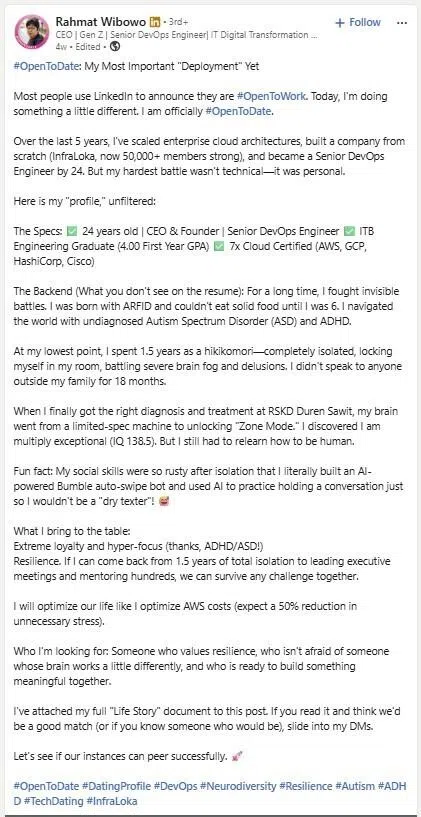
The appeal for Mr Rahmat Wibowo is that LinkedIn dramatically widens one’s visibility beyond immediate social circles.
PHOTO: RAHMAT WIBOWO/LINKEDIN
Within a month, Mr Wibowo says he forged two relationships through LinkedIn.
One Indonesian woman, a 25-year-old lawyer, discovered him two weeks ago after seeing his post about an AI legal product he was developing.
“She was interested in what I did,” he says. “And somehow, we just started dating.”
A woman he met through LinkedIn in April briefly became his girlfriend, although the relationship fizzled out because they lived several hours apart in Jakarta.
The appeal for him, Mr Wibowo says, is that LinkedIn dramatically widens one’s visibility beyond immediate social circles.
“LinkedIn can connect you with different cities, different countries,” he reflects, adding that women outside Jakarta – and even overseas – began discovering his profile organically through the platform’s algorithm after his posts went viral.
He posits that LinkedIn dating works only if users possess some form of visibility or credibility online – which he spent years building before posting about dating.
Part of why the platform appealed to him came down to verification.
“You can’t verify someone’s background on a dating app,” he says. “But on LinkedIn, everything is verifiable.”
While LinkedIn users mostly reacted positively or curiously, users on X mocked his quest for love on the platform as “delusional”.
Mr Wibowo remains unfazed.
“What can I say?” he says with a laugh. “I’m a risk-taker. I don’t care what people say, as long as I’m confident in myself.”
He even believes LinkedIn’s infrastructure could eventually evolve into a functional matchmaking system. An AI product he is working on, he reveals, involves scraping LinkedIn profiles and ranking compatibility between potential romantic partners, deploying the same methodology used in recruitment software.

Matchmaking agency Lunch Actually’s sponsored text on LinkedIn.
PHOTO: COURTESY OF EMILY KOH
This hunger for human connection has not gone unnoticed by matchmaking agencies, with Lunch Actually and GaiGai increasingly advertising on LinkedIn, sending sponsored messages to professionals on the platform.
For Lunch Actually co-founder Violet Lim, the logic is straightforward.
“Our clients – doctors, lawyers, bankers, entrepreneurs – they’re not scrolling dating apps between meetings,” she says. “They’re on LinkedIn.”
She believes it works, precisely because users are not entering the platform looking for romance, instead presenting what she describes as their “most credible selves” through their careers, achievements, public posts and professional reputations.
“You can see their trajectory, their values through what they post, who vouches for them,” she says, contrasting that with dating profiles “curated mostly for physical attraction”.
Lunch Actually identifies high-achieving professionals – often in their 30s and 40s – who appear successful in many areas of life. As LinkedIn does not indicate whether users are single, the agency makes clear in its outreach that its services are intended for singles seeking long-term relationships.
Ms Lim says many users they approach admit they had been thinking about seeking help with dating.
“The people who come to us from LinkedIn have done their homework,” she adds. “They arrive ready to look for a serious relationship.”

Lunch Actually co-founder Violet Lim says LinkedIn’s professional ecosystem allows matchmaking agencies to reach career-driven singles.
PHOTO: COURTESY OF VIOLET LIM
Dating apps, in contrast, increasingly feel exhausting to many professionals, with Ms Lim summing up the experience as an endless cycle of “swipe, match, ghost, repeat”.
Lunch Actually has already seen over 20 marriages emerge from its LinkedIn outreach efforts, while a “meaningful portion” of new client inquiries over the last year have also come through the platform.
In 2025, software engineer and content creator Varick Lim, 32, turned to LinkedIn to recruit contestants for an AI-powered dating show inspired by The Bachelorette (2003 to present). It featured artificial intelligence interviews with male and female participants, analysing their conversations and eventually selecting the “most compatible” match.
He says posting the recruitment call on the platform was less a calculated strategy than a practical decision. As someone who regularly posts AI-related content there with an audience of around 4,000 followers, LinkedIn simply expanded the pool of people he could reach.
“I did pause to ask myself, ‘Is this even appropriate?’” he recalls.

Mr Varick Lim said posting the recruitment call on LinkedIn was less a calculated strategy than a practical decision.
PHOTO: VARICK LIM/LINKEDIN
But the recruitment post eventually drew around 7,500 impressions and 86 reactions, leading one LinkedIn connection – a former work acquaintance – to sign up as the show’s bachelorette.
The YouTube dating show, which aired in June 2025, featured five male contestants, two of whom applied to join. Three were recruited by Mr Lim.
Although the “winner” selected by AI did not end up dating the contestant, the experience reinforced for Mr Lim how the lines between networking, work and social life have blurred online today.
Singaporeans, he feels, are deeply pragmatic about dating, particularly when it comes to their partner’s career and education.
“In Singapore, job title and company are honestly a big part of how people evaluate a potential partner,” he says. “LinkedIn has a lot of useful signals for that.”
Even as LinkedIn users experiment with dating posts and matchmaking outreach, the platform still occupies an awkward middle ground where most people remain unsure which personal quests are appropriate.
As Mr Lim puts it, overt flirting in a professional space can come across as awkward, spammy or desperate.
LinkedIn itself appears eager to maintain that distinction, in response to queries from ST.
“LinkedIn is a place for professionals to connect, grow and succeed, whether it’s landing a new role, building a business or expanding their network through meaningful conversations,” says a spokesperson, adding that “romantic advances or harassment” violate the platform’s policies.
Still, users continue to push at those boundaries, something Prof Lew believes reflects broader shifts in online behaviour and self-presentation, more than LinkedIn itself evolving into a dating platform.

Assistant Professor Lew Zijian of NTU’s Wee Kim Wee School of Communication and Information says the issue is less about whether LinkedIn should remain strictly professional, and more about how people behave on it.
PHOTO: COURTESY OF LEW ZIJIAN
Despite being designed for professional networking, he notes that the platform contains many of the same mechanics as other social media apps – public profiles, self-presentation, visible social networks and direct messaging functions.
“The pioneers of LinkedIn dating may be negatively judged for being inappropriate,” he says. “But as more people adopt similar behaviours, over time, such behaviours will be deemed more appropriate.”
He argues that the issue now is less about whether LinkedIn should remain strictly professional, and more about how people behave on it.
“What’s inappropriate is being a nuisance to others – pestering potential partners after being rejected, stalking behaviours and so on.”