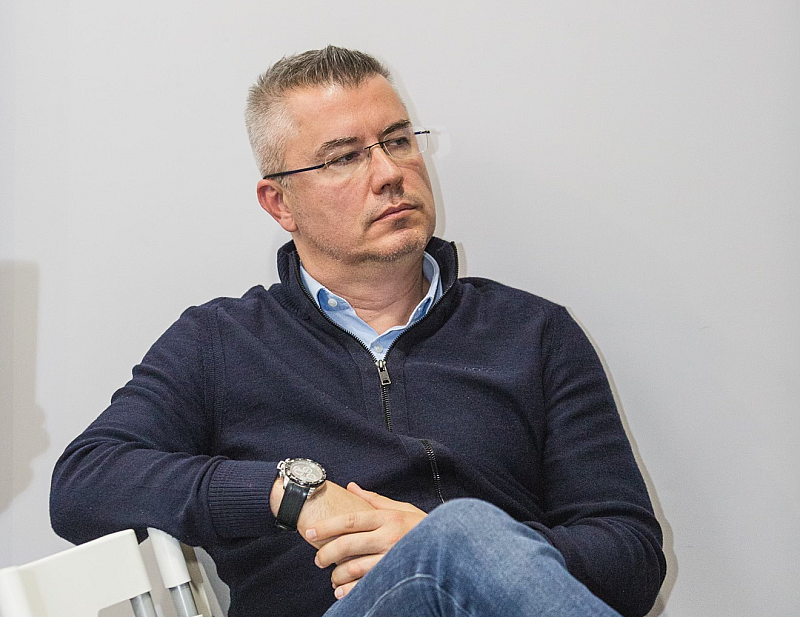
In an interview with FrogNews, Vladimirov commented the new report of the US State Department “United States Policy to Promote Stability and Prosperity in the Western Balkans”which portrays the region as an area of competition between the US, Russia and China, with a particular emphasis on energy security and limiting Russian influence.
According to him, Bulgaria can play a much more important role in the energy supplies to the Balkans and Central Europe after the war against Ukraine, including due to the expected huge energy needs of Kiev.
“Any talk in the direction of Russia, Moscow, Putin would defocus these strategies,” warns Vladimirov.
According to him, such signals would weaken the confidence of the allies in the EU and NATO precisely at a time when Bulgaria has a chance to position itself as one of the main energy hubs in the region.
Here is the full interview:
The report presents the Balkans as an area of competition between the US, Russia and China. How does such an influence manifest itself in practice?
Each of these major geopolitical players has a different approach, a different concept and a different history in the region. This largely determines the way he manages his interests.
Russia is the oldest player in the Balkans. We know the historical events in which he participated – the wars with the Ottoman Empire, etc. It has long-standing instruments of influence, which we can briefly describe through ideas such as Slavism, Orthodoxy, and historical proximity. It is through them that Russia in various periods, including today, manages to influence public attitudes in the Balkans.
With the advent of social networks, the capabilities of Russian services have grown tremendously. In practice, especially Facebook, it has become a real “brave new world” for them, where they can do almost anything they want. Such type of undemocratic and asymmetric soft power and propaganda engineering was not foreseen in the creation of these social networks.
On the other hand, China is no less capable in this direction. The Chinese have enormous capacity. We see that they have a global strategy that also affects the Balkans – they are building the image of China as a friend and partner that can build, invest and develop infrastructure. This is also the main difference with the Russian vision and propaganda – the Chinese are more pragmatically oriented and present themselves as a possible strategic partner for any country.
Their message is: let’s be friends, let’s develop infrastructure, business and investment together. But, of course, both countries, being non-democratic, have no problem using various tools, including corruption and asymmetric hybrid actions towards the Western Balkan countries.
The US, with this report, is saying something different and new. America seems to be saying to the Balkans: “Until now, we have dealt with you as small children, it is time for you to grow up and work together in a new way – as more mature societies and countries, to do business and develop projects that can be more profitable and more interesting than what Russia and China offer.”
This document also talks about the need to limit Russian interference in the internal affairs of the Balkans. What tools does the US actually have to achieve this?
Russian influence, apart from the media, social networks and local pro-Russian circles, has long relied on one of its strongest weapons – I use the past tense deliberately because its power is gradually waning – energy.
The sale of oil and gas was a tool that Russia successfully used in a different way. Apart from the “Balkan Stream” that feeds Serbia, Hungary and Slovakia – for now its partner countries, although we are seeing changes in Hungary’s policy – Russia does not have such strong mechanisms to influence the Western Balkans.
To a much lesser extent, it has an economic impact. Its political, intelligence and hybrid influence is stronger than the economic leverage Moscow has, unlike China, which has a huge exposure in Serbia and Montenegro. In Serbia, we are also talking about a very large credit exposure at very serious interest rates.
Only God knows the amount of Chinese loans extended to the Serbian government and President Aleksandar Vucic.
The US is not saying, “We’re going to step in and get our piece of the Balkan pie.” They want to take more serious positions and are already developing parallel energy and infrastructure projects – building highways, gas pipelines and investing in connectivity.
I believe that once the US has made the Balkans its focus, it will achieve the results it has set for itself. This is part of President Trump and his administration’s more pragmatic approach to geopolitics – more business and less politics.
The Americans know where they stand and have a relatively clear strategy and ideas for developing infrastructure and connectivity. US policy on the Western Balkans is largely coordinated from its embassy in Athens and the ambassador there, Kimberly Guilfoyle, who is close to Trump, his family and the administration. They are extremely active and this activity will increase in the coming months and years.
How could Bulgaria benefit from a business point of view?
Geography defines much of geopolitics – it is one of the oldest principles. Bulgaria has an almost perfect location, but I’m not sure it has the perfect governance to take advantage of it.
So far we have not shown that we can use this advantage to its full extent. I hope that the future governments of Bulgaria will take real actions, and not just make plans and policies – for more serious connection with the neighbors, for the development of the Vertical Gas Corridor, for increasing the cross-border capacities for the transmission of electricity and gas.
It is important to consider the Black Sea as well – the ports, logistics, supplies and energy infrastructure, including the role of the Lukoil refinery and the dependencies built up over the years around it. All this is part of the big picture of how Bulgaria can position itself – whether as a transit, energy and logistics center, or as a country that misses its opportunities.
This is the key thing we need to do in the coming months and years. The war against Ukraine will eventually end. Then there is a great opportunity for Bulgaria to supply not only the Balkans and the Western Balkans with fuel, gas and electricity, but also the emerging new Central European block between Poland and Ukraine.
Personally, I think that Ukraine has a very serious future as a country and will need huge amounts of energy, some of which can come through Bulgaria. If we manage to build and protect such a large-scale energy infrastructure, together with the US, we could turn out to be entirely profitable, as long as we think and work in this direction and in sync with our partners in the European Union and NATO, including Turkey and Greece.
Negotiations are currently underway for a large American company to acquire Lukoil’s assets. This means that it is possible for Neftohim Burgas to have an American owner on the Black Sea coast, since there is practically no company in Europe with the necessary capacity and capabilities to manage and protect such a large energy infrastructure.
These are the key directions and corridors that we need to develop so that in five or ten years we can say that Bulgaria is truly one of the main energy hubs in the Balkans.
Any talk about Russia, Moscow, Putin, etc. would defocus these strategies and send a bad signal to our allies and partners in the EU and NATO. The rhetoric that the Bulgarian government sometimes tries to push is not good for Bulgaria’s national interests.