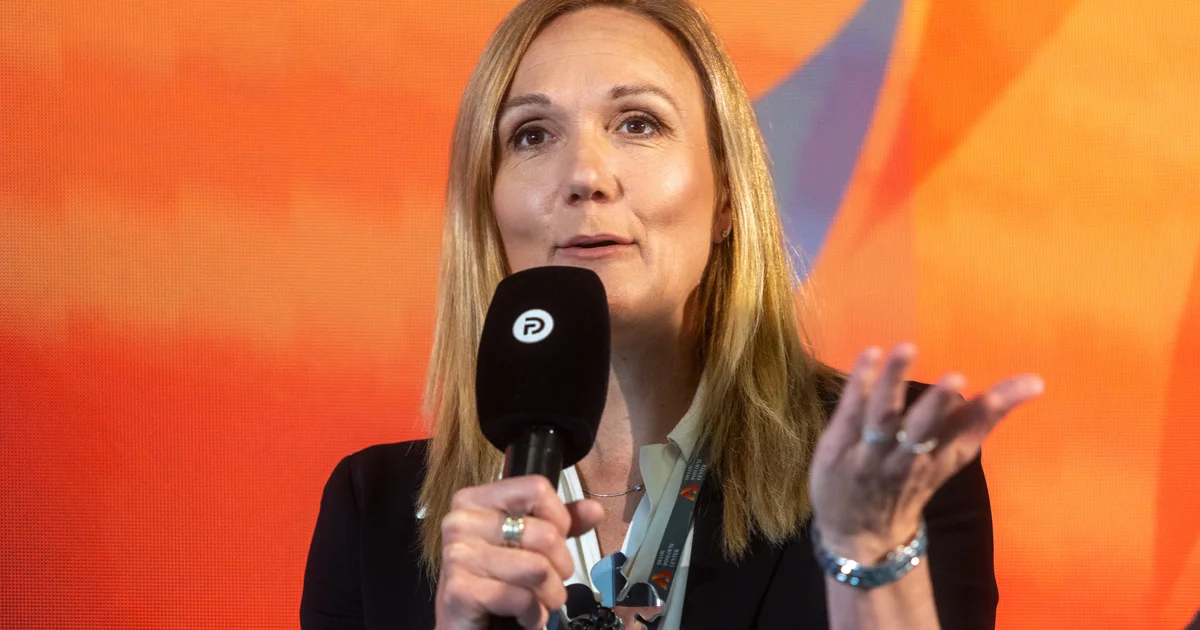
See what Petra Majdič had to say about the “10 percent” that, according to her, is most lacking in sports today:
Even today, Petra Majdič speaks the way she did when she competed: directly and without embellishment. Because she knows how to say what others often prefer to keep to themselves, after the end of her career she remains one of those athletes that people like to listen to.
“We celebrate individualism and this is our biggest mistake,” she said at the round table More than the game: the business, technological and ethical foundations of elite sportwhich was organized by Del’s Business Center and took place as part of the conference Sports. The speakers discussed the future of sports sponsorships, stronger teams and the role of businesses, media, volunteers and the community.
Petra Majdič was not interested in old victories and sports nostalgia. She was much more interested in what was happening with people, society and athletes today. She warned that sport cannot survive in the long term without team spirit, volunteerism and people who are willing to give something back to the community.
Check out what happened at the conferencewhere many successful athletes and businessmen presented their stories.
“Without volunteerism, sport will not survive”
Petra Majdič spoke with the interlocutors at the round table about a topic that is not as shiny as medals, but is much more fatal for sports. According to her, the sponsorship pool is getting shallower, so the sport will again have to rely more on people who are willing to give something back. Not only money, but also time.

Petra Majdič was very clear about individualism: if everyone only builds their own story, sooner or later the common one will run out. PHOTO: Voranc Vogel
“Without volunteerism, sport will not survive, whether we like it or not,” she said, adding that everyone should give back a part of themselves to society. Her long-standing thesis is simple: “Everyone should give 10 percent of their time or 10 percent of their income back to society.”
She did not stop at calling others. She said that she herself has been doing this for a long time, according to the rule that she donates part of her income anonymously. As she explained, her colleagues asked her why she was doing this, saying that sponsors would take care of the sport. Her answer was clear: she was helped when she needed help, so she thinks it’s right to give something back to society today.
She also thinks more broadly, as she is convinced that we should extend this sense of belonging to various spheres of our everyday life. She also mentioned culture and the wider community, and above all, the sense of belonging, which, according to her, is less and less in society. Volunteering would bring people together again: working for a few hours, helping with a local event, landscaping, supporting a club, association or match.
“Instead of us all rushing to the sea or to the hills on Saturdays and creating traffic jams, the village could gather together and rebuild something together. You give back ten percent of your time without asking why. Simply because it’s right.”
“We celebrate individualism and this is our biggest mistake”
She was also very direct about the conversation about our society and how much we have become accustomed to emphasizing the individual, personal success and our own recognition. According to her, this is precisely where the problem arises. “We celebrate individualism and that’s our biggest mistake,” she said rather harshly. At the same time, she warned that social networks do not connect people as much as we think, but often make them even more isolated. Even in sports, according to her, everything revolves too much around individuals, names and headlines, and much less around the teams and communities that bring the athlete to the top in the first place.
She also spoke very honestly about something that sports fans don’t often hear. “I don’t really care if Domen, Peter, Cene, Timi Zajc or Lanišek wins, as long as he is Slovenian,” she said, showing quite clearly how she understands sports. Not as a contest of egos, but as a shared story.

Many well-known faces from the world of sports performed at the event: Filip flisar, Domen Prevc, Petra Majdič, Toni Mulec and Miran Stanovnik. PHOTO: Voranc Vogel
Petra Majdič on why losing touch with yourself is the most dangerous thing when it comes to sports fame. Watch the video:
“In the end, only the tombstone remains”
From the critique of individualism, Petra Majdič quickly came to the question of what remains after a person. If everything revolves around the individual, headlines, money and momentary fame, she says, the point is being missed. “The tombstone doesn’t say how much you have in your bank account, how much you’ve made or how much you’ve left to your children,” she said. According to her, what remains at the end are mainly the people you create around you and the successors who continue the story.
Therefore, according to her, it is not enough for an athlete to think only about his own career and recognition. “But who carries your name forward? Successors,” she emphasized. She was thinking not only of the family, but also of the young athletes, the teams and the environment that you help to build.
With this, she placed fame in a wider context. Successes pass, the sports journey comes to an end, but the question remains, who did you open the door to and what did you help set up for those who come after you.
“It’s sad to go out for a beer alone”
In the end, it all came back to a very simple thing: man needs people. Even if he was the champion, even if he was on the headlines, even if all of Slovenia once knew him. Success without relationships quickly becomes quite empty. Petra Majdič therefore summed up her thoughts on teams and networking in a very homely way: “It’s really sad that you go out for a beer alone. You have to have someone to go out for a beer with.’
With that, she returned to connecting and concluded with a very simple initiative: we need to start building together again.