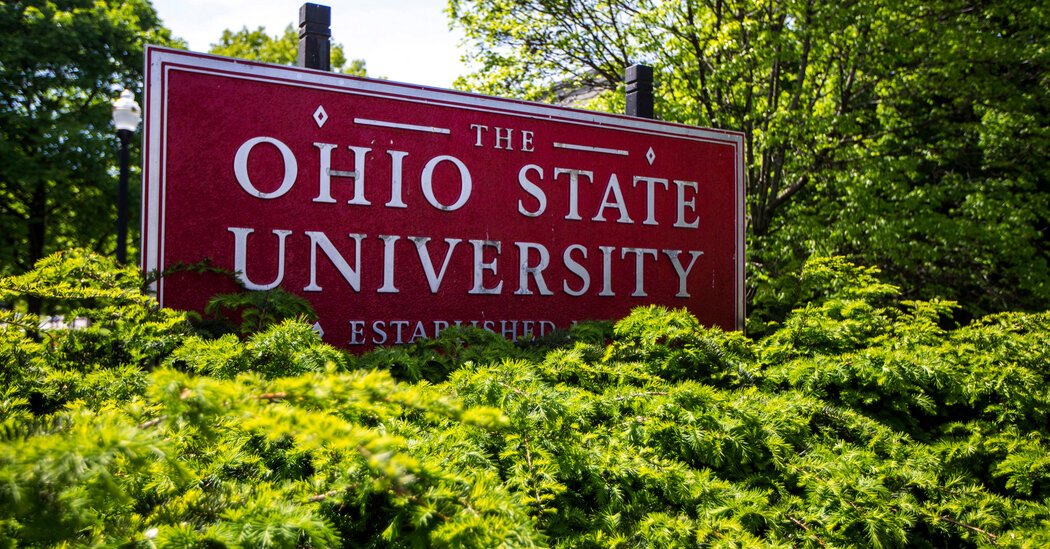
Ohio State University has reached a preliminary agreement to pay $100 million to 279 former students who said they were sexually abused by a former athletic team doctor, the latest group to strike a deal with the college in the long running case.
The settlement, which was ratified in principle by the university’s board of trustees in a meeting on Wednesday night, would resolve all but one of the remaining 280 plaintiffs’ claims.
Previously, Ohio State had paid out more than $61 million to 317 people who claimed they had been abused by Dr. Richard Strauss, an athletic team doctor from 1979 until he was fired in 1996. Dr. Strauss died by suicide in 2005.
Ohio State’s president, Ravi Bellamkonda, said that resolving the claims was important to the university. “We continue to be grateful for their courage in coming forward,” he said of the former students.
A lawyer for some of the plaintiffs did not respond to a request for comment. The judge in the case had instructed the parties not to discuss the settlement until it was finalized.
“We will provide additional information when we are in a position to do so,” John Zeiger, the outgoing chairman of the board of trustees said at the meeting.
Several factors appear to have driven the parties toward an agreement.
In April, the judge, Michael Watson, rejected Ohio State’s motion to restrict damages to tuition costs, allowing the plaintiffs to recoup more money. Last month, more than 30 former Ohio State football players — including three members of the 1980 Rose Bowl team — joined the lawsuit.
And earlier this year, the judge ruled that Les Wexner, a prominent Ohio State alumnus under scrutiny for his ties to Jeffrey Epstein, must sit for a deposition. Mr. Zeiger has been Mr. Wexner’s longtime personal lawyer.
The parties went back to mediation on May 11 ahead of an October trial date. But left open was the possibility of former Ohio State football players — including the two-time Heisman Trophy winner Archie Griffin, who has been deposed in the case — taking the witness stand as the upcoming season played out.
“I think the judge’s decisions had a lot to do with it,” said State Senator Bill DeMora, whose district includes Ohio State. “A trial would have been ugly. It would have been terrible for the university and it would have done damage to our football program.”
Though the abuse allegations against Dr. Strauss were known around Ohio State for years, they had been kept out of the public eye until 2018 when a former wrestler, Michael DiSabato, came forward with accusations that Dr. Strauss had abused him. Mr. DiSabato is among the few plaintiffs who have chosen to be named.
As more came forward, Ohio State hired a law firm to investigate. A 182-page report, released in 2019, found that Dr. Strauss had sexually molested at least 177 men, including many varsity athletes. Plaintiffs have said that figure undercounts the abuse.
The report detailed instances of athletes who visited the doctor for a variety of ailments — such as a sore throat or an ear problem — only to have Dr. Strauss fondle their genitals as part of the examination. The accounts were so numerous, the report said, that investigators elected not to include an exhaustive accounting of each one.
The report also said more than 50 athletic department staff members and others had been aware of the doctor’s misconduct but did nothing to stop it. Though Dr. Strauss was fired in 1996, he was allowed to retain his tenured faculty position for two more years.
Many former wrestlers have said that the influential congressman Jim Jordan, a former assistant coach, was aware of the conduct by Dr. Strauss, who, according to one of the lawsuits, was known among them as Dr. Jellypaws. Mr. Jordan has denied knowing about it.
The claims are not unique among Big Ten universities.
Michigan State paid out $500 million to the victims of a former team doctor, Lawrence G. Nassar, who is serving a life sentence for sexually assaulting gymnasts. Penn State has paid close to $130 million to the sexual abuse victims of a former football coach, Jerry Sandusky, who is in prison. And the University of Michigan paid out $490 million to more than 1,000 athletes and students who said they were abused by a former team doctor, Robert E. Anderson, who is deceased.
The Strauss case has dragged on for more than eight years, remaining in the background as other scandals have played out at Ohio State. This year, Walter Carter Jr. resigned as university president after disclosing that he had an improper relationship with a woman who sought public funding for a podcast. A professor assaulted a journalist outside a classroom. And protests demanding that Mr. Wexner’s name be removed from campus buildings gathered momentum as his ties to Mr. Epstein emerged.
“It’s ludicrous that it took this long,” Mr. DeMora said. “I’m happy the university is done with the stain of this chapter and that there’s some closure for the victims of this horrible abuse.”